This article was originally published by Boyle Heights Beat, a nonprofit newsroom serving Boyle Heights and the eastside.
On a lot next to the cultural Casa del Mexicano landmark in Boyle Heights, Omeatl Tonatiuh and his family raise 18 hens that collectively lay nearly a dozen eggs daily.
“We tried selling them, but we’re like, you know what? I don’t need to be selling [my neighbors] eggs, so I just give them away,” said Tonatiuh, 45, who rents the plot of land to use as a family farm.
With the nationwide egg shortage that has caused prices to skyrocket, Tonatiuh of Boyle Heights feels “there’s a sense of rebellion in raising chickens,” especially at a time when the cost of eggs has become a political talking point about how weak or strong the economy is.
Eggs have been “one of the most affordable things for the most amount of nutrition,” said Tonatiuh. “When something goes up that is such a big part of our daily life, like eggs, it affects us, and that’s the part that politicians and billionaires don’t understand.”
“We try to take care of the community as much as we can,” he said. “All my neighbors here, they all get eggs. They say, ‘Tiene huevos?’ And we give them a carton of eggs.”

Support Boyle Heights Beat
Tonatiuh is among the Eastside residents whose chicken coops are helping provide eggs to their neighbors–either for free or at a discount–amid an outbreak of the deadly H5N1 strain of avian flu that began in 2022.
For months, the virus decimated egg-laying chicken farms, limiting egg availability across the U.S. and driving the average wholesale cost of a dozen eggs above $8 in February.
However, wholesale egg prices began to drop this month as bird flu outbreaks appeared to slow. The U.S. Department of Agriculture’s weekly Egg Markets Overview report–the latest released on Friday–shows wholesale egg prices at $3.27 per dozen, continuing a downward trend, though at a slower pace than the previous week.
“Consumers are slowly beginning to see downward price adjustments and increasing availability,” according to the report.
Meanwhile, in Lincoln Heights, residents continue to rely on Doug Patzkowski and his hens.
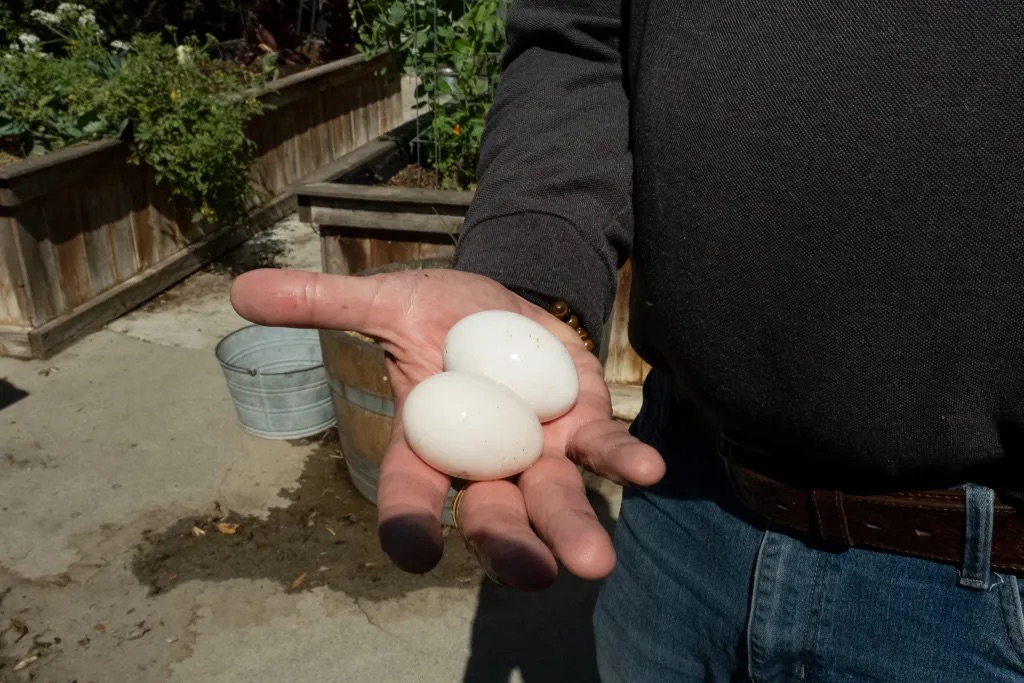
Patzkowski, 67, feeds his eight hens natural food and greens from his garden. The hens, including a Red Laced Cornish and a Black Langshan, lay between two and three dozen eggs a week. He plans to add six chicks to his flock in April and expects the hens to be laying their first eggs in the fall.

Doug Patzkowski, pictured above, raises eight hens in his backyard chicken coop in Lincoln Heights. Patzkowski’s chickens lay roughly two dozen eggs a week. Photo by Andrew Lopez/ Boyle Heights Beat.
The hens he has now are older and produce fewer eggs, but it’s enough supply for Patzkowski and his neighbors.
“I have some neighbors that want them, and so I just sell them – not for a lot of money, but it helps pay for their feed,” Patzkowski said.
Eva Lu is one of those neighbors.
Lu is grateful for Patzkowski, her local egg salesman, who helps supply her with enough eggs to feed herself, her daughter, and, occasionally, her dogs.
“I’m so grateful because my friends keep asking if I worry about egg prices at the store, and I’m like, no, I don’t need to. I get eggs from my neighbor,” Lu said.
Lu said she isn’t able to raise chickens at her home, but appreciates the thought of self-sustainability that comes with growing food.
“If I had a bigger backyard, I’d love to raise chickens, maybe grow my own vegetables. I like the way that we used to live, like in the olden days. Everybody would live more happily, I think,” Lu said.