
In wildfire-prone Los Angeles, growing native plants feels like a somewhat radical act.
Once dominated by coastal scrub, chaparral, and other native species, California’s landscape has been fundamentally reshaped by invaders.
No, not the so-called “invaders” that the Trump administration wants you to worry about.
In the case of California’s topography, as with many historical happenings, European colonizers are the ones to blame: Imported by Spanish missionaries centuries ago, invasive plants strangled the region’s natural vegetation and swept the land.
Wild mustard, for example, is an invasive Mediterranean plant species introduced to California habitats in the 18th century. Though beautiful, the deceptive yellow blooms that rapidly overtake landscapes are especially prone to wildfires.
“It spreads like crazy, and it just takes over,” Amy Greenwood, the director of the Theodore Payne Foundation for Wildflowers and Native Plants, tells L.A. TACO. “Then, when it dries out, it becomes flashy fuel.”
According to Theodore Payne’s invasive plants guide, “flashy fuel” is combustible plant material that “ignites easily and burns quickly,” such as dry grasses and pine needles.
“People don’t realize that with invasive plants comes a greater risk for fire,” says Greenwood. “Mustard is a big one that’s very easy to recognize.”
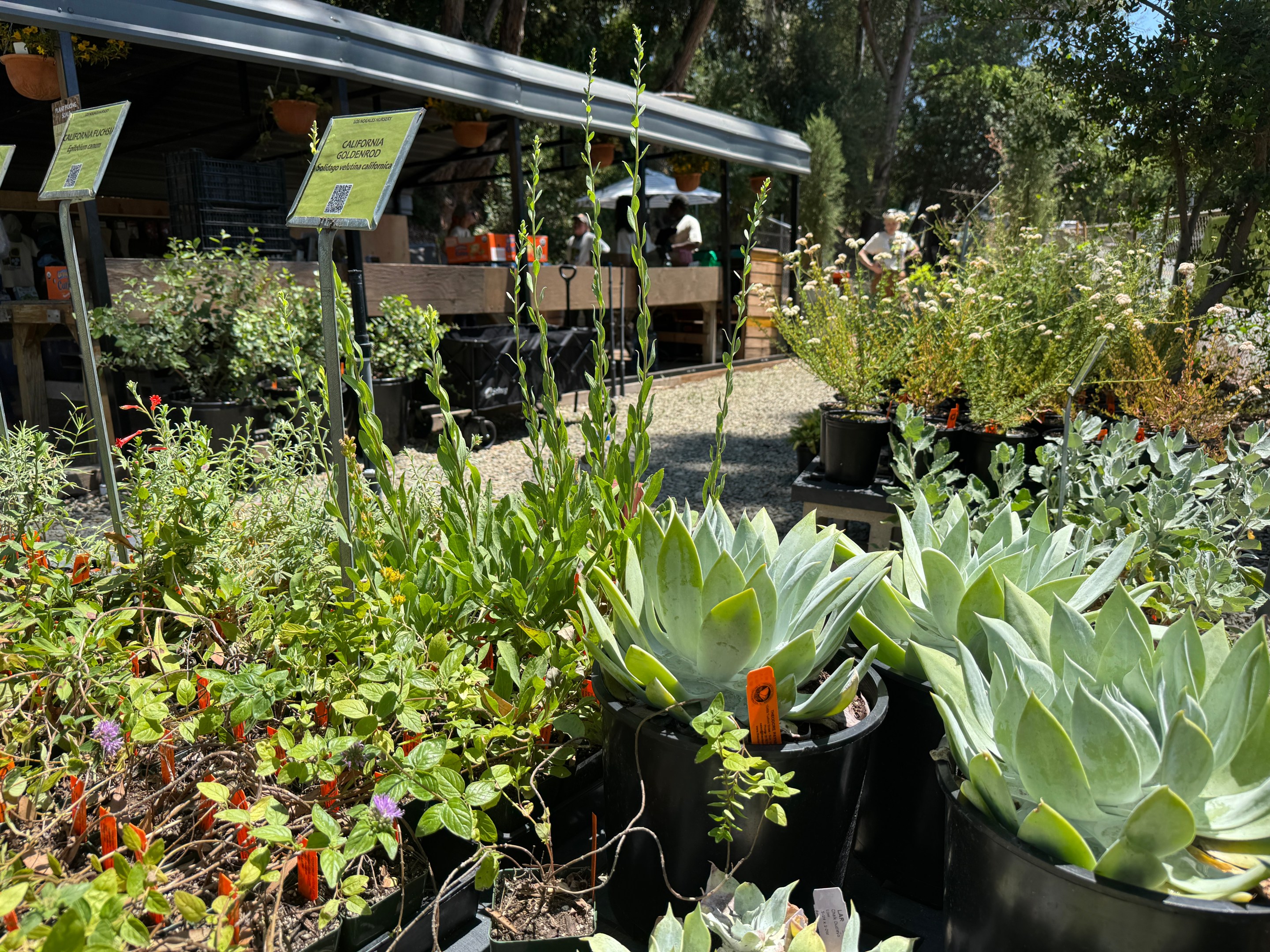
Wildfire mitigation is one way that the Theodore Payne Foundation hopes to help Angelenos; in addition to its free educational resources on native plants and habitat restoration projects, the nonprofit just opened a brand new native plant nursery in Northeast L.A.
Tucked away next to the Audubon Center at Debs Park, which partners with Theodore Payne, Los Nogales Nursery is open to the public for the first time.
Named after the California black walnut, which is a symbol for Indigenous resilience, the new nursery offers more than 30 species of California native plants grown from local seeds.
“Part of the reason why they do a good job of mitigating wildfire risk is because they’re adapted to low water conditions. Once you get them established, certain types of native plants remain green with very little water.
“They don’t dry out, so they’re less likely to burn.”
For many Angelenos, the recent wildfires that devastated large parts of Southern California are still top of mind.
Though multiple contributing factors sparked the wildfires in January, including the worsening effects of climate change, non-native, invasive plant species are another, less-publicized culprit
The non-native palm tree, an enduring, if not problematic, symbol of Los Angeles, faced heightened scrutiny when images spread of the exotic trees engulfed by flames during the fires.
At the time of publishing, the massive Gifford Fire is sweeping parts of Santa Barbara and San Luis Obispo, and as the region braces for a heatwave, there’s certainly more wildfires to come.
But Angelenos aren’t completely powerless when it comes to fire mitigation.
According to one of Theodore Payne’s many educational guides, California natives, such as coyote brush, coast live oak, and toyon can provide protective cover in areas prone to drought and wildfires.
“An oak tree, for instance, has a coating on it that will grab embers and sequester them in a fire,” Greenwood tells L.A. TACO, “So, the native plants can actually help your yard.”
Evelyn Serrano, the director of the Audubon Center who works in partnership with Los Nogales Nursery, proudly points to an old photograph that hangs inside the entrance building.
Dated circa 2003, the photo shows a barren hillside dotted with sparse shrubs.
“Look at that bare hillside, right?” Serrano says. “We do a lot of habitat restoration, so we use those California native plants, and that’s what you see all across here.”
Now, when visitors hike or drive up the hillside of the Audubon Center, lush plant life is abundant in every direction. In contrast to the 20-year-old photo, wildflowers and greenery swarming with butterflies and bees blanket the landscape.
“You can see how much it’s changed over the years,” Serrano tells L.A. TACO.
“At our core, we want to bring back those native plants. It’s what we have as our roots, it’s what we’ve connected to, and it’s what has evolved with the ecosystem for thousands of years.”