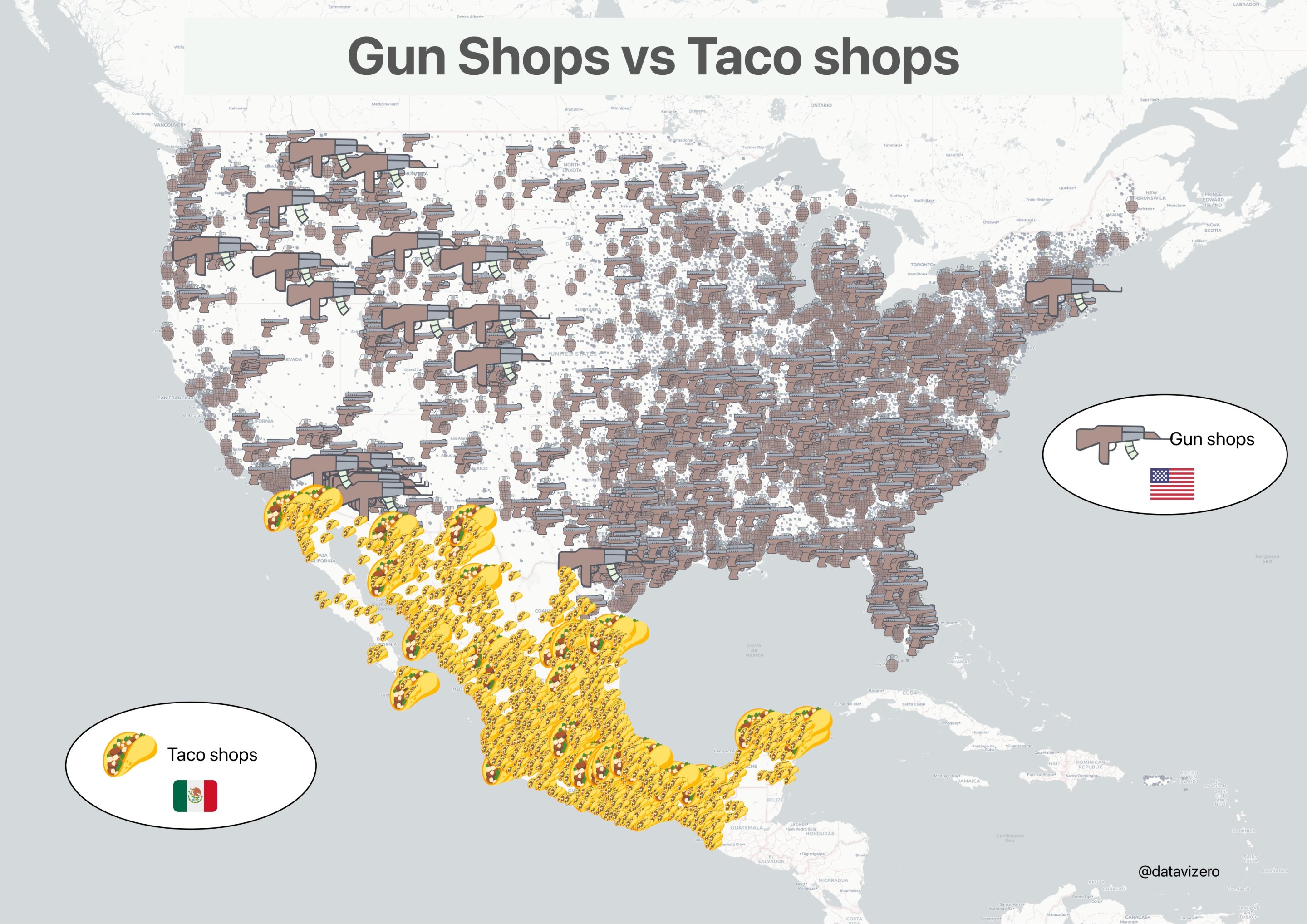
At first glance, comparing the number of taquerías in Mexico to the number of gun shops in the United States might seem like a pointless exercise—after all, who would be surprised that Mexico’s 140,000 taco stands outnumber the U.S.’s 80,000 gun dealers?
That's TACO POWER!
Yet, Mexico City data journalist Baruch González has gone and crafted a visualization that is as thought-provoking as it is playful.
Inspired by the current political tensions between the U.S. and Mexico, where tariff wars overshadow the role of American firearms in cartel violence or Americans' obsession with Mexican fentanyl, González’s work highlights two realities: Mexico’s vibrant culinary culture, anchored by tortillas, and embodied by the beloved taco, and the widespread accessibility of guns in the U.S., particularly near the border.
Drawing from official data sources, his graphic underscores a stark contrast between cultural richness and the sobering reality of gun proliferation.
In a world where U.S. gun violence, including school shootings, regularly gets called out by Mexican nationals when asked the inevitable question, "But isn't Mexico dangerous?," González’s project invites reflection with a simple message: Tacos, not bullets.
Let’s explore the data and impact behind his compelling comparison with González himself.
L.A. TACO: What inspired you to create this graphic?
Baruch González: The inspiration for this graphic came in a context of political tension between the U.S. and Mexico. The Trump administration accused Mexico of high levels of violence linked to drug trafficking, but it never mentioned that much of that violence is carried out with American guns. This data visualization aims to highlight two things: first, that Mexico is not only about violence, but also about its richness—in this case, culinary richness through our emblematic dish, the taco. Second, it seeks to show the easy accessibility of firearms in the United States, particularly through the many dealers concentrated along the border with Mexico.
Where did you get the data from?
The data on gun dealers came from an official database created by the Bureau of Alcohol, Tobacco, Firearms and Explosives, which lists 11 types of licenses. The data on taco dealers came from Mexico’s National Institute of Statistics and Geography (INEGI), which provides information on the country’s economic activities, including food shops.
Do you have an approximate list of places for each category?
For gun dealers, there are around 80,000 records across the United States; however, the largest share is located in Texas. As for taco dealers, the mapping shows about 140,000 shops across all of Mexico.
What kind of reactions have you received? Positive or negative? Any gun lovers from the U.S. trying to get crazy yet?
In general, this visualization—with its political undertone—has received positive reactions, often summed up in the phrase “tacos, not bullets.” There have also been comments pointing out the hypocrisy of politicians who claim to seek peace while maintaining lax policies on illegal arms trafficking. On the other hand, there has been push-back from those who defend their right to own a gun for self-protection.
You live in Mexico City, and the topic of gentrification is a big one. How do you navigate that as a Chilango with the people you interact with in your daily life and the businesses you support?
Gentrification in Mexico City is a very important issue right now. When it comes to tacos, there has been a documented process of “gourmetization.” This means that traditional foods like tacos have been taken up by large investors to create more expensive versions with gourmet ingredients. What once cost about one or two dollars for a taco, you can now find in tourist areas for as much as $40 a piece. Because of this, another saying has emerged in Mexico City: “the salsa doesn’t burn anymore.” This reflects the idea that, in order to satisfy foreign palates, our food is no longer made as spicy as it traditionally was.
Thank you for speaking with us.