Long before Hollywood’s cameras framed Los Angeles as a dream world, our city was a proving ground for hope, reinvention, and a framework for who the U.S. allows to be seen and endowed with opportunities.
From Black southerners migrating west in the early half of the 20th century, to Central Americans escaping the terrors of civil wars at home in its later half, Los Angeles has stood as a place of survival, renewal, and safety, even despite their confrontations with a new breed of pressures and struggles in L.A.
The new HBO series I Love L.A. imagines the city through a narrow lens of arrival and aspiration, yet within that gloss lies an old story: of who gets to belong to the myth of Los Angeles, and who must labor, unseen, to sustain it.
But what is an L.A. show and what we should demand, and not simply ask for, when we want to see the city on screen?
Los Angeles looks familiar in I Love L.A.: the sunsets, the studios, the promise that somewhere west of the 110 Freeway, a new life waits to begin.
But beneath that light is a city still negotiating who it belongs to. The series wants to say something about ambition through comedy and satire, but like many shows and projects before it, it mistakes proximity to Hollywood for a form of tongue-in-cheek, generational, internet authenticity and leaves the rest of Los Angeles, the one outside of the westside–the one that works, commutes, and survives here–out of frame completely.
It's "Entourage" without the misogyny, with influencers in place of actors, and a good amount of coke on screen. While the latter did receive mixed reviews and exceptions, the 2000’s HBO show focused on Hollywood and the industry and didn’t aim to be a representation of Los Angeles.
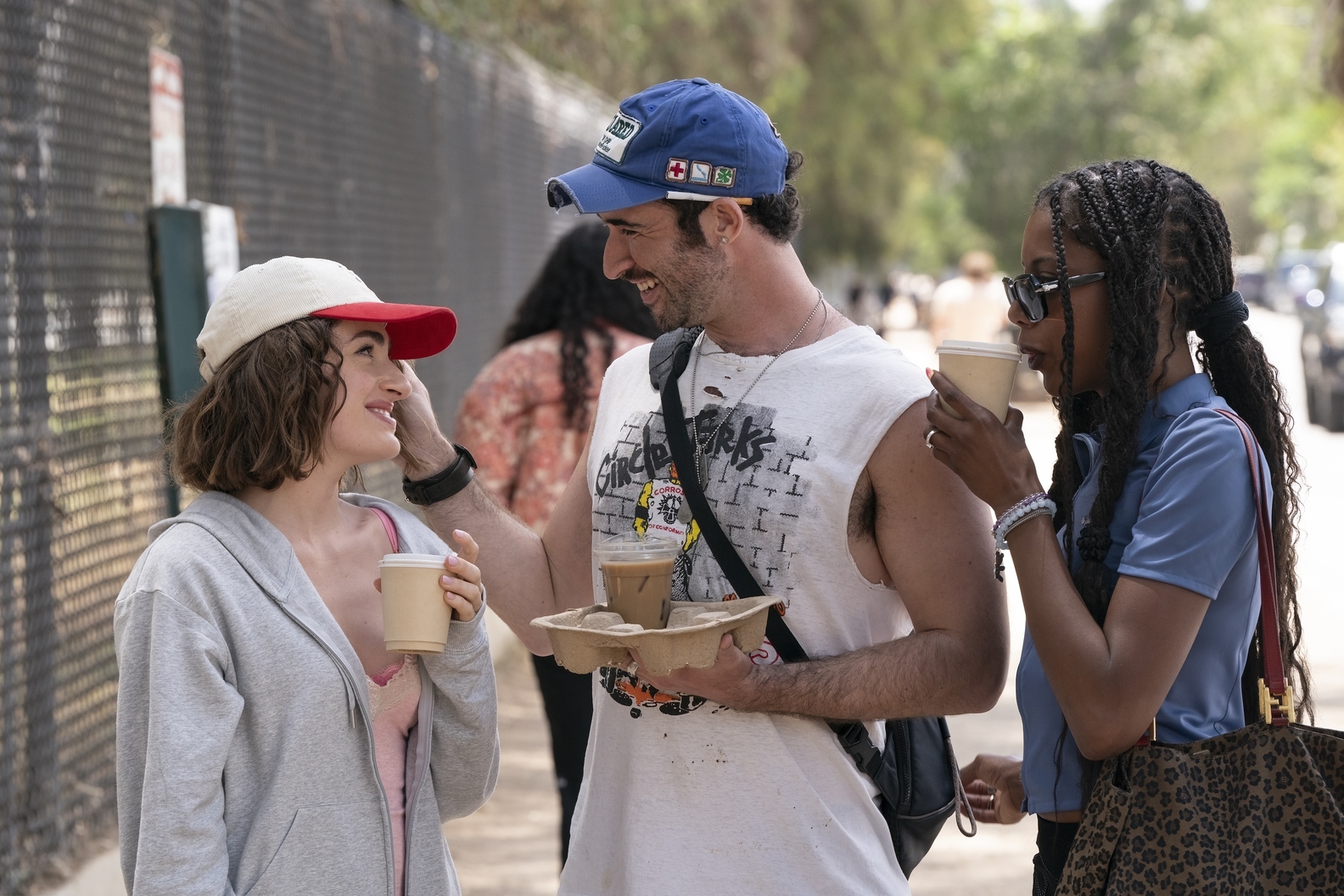
The show follows an aspiring talent manager whose best frenemy, a popular influencer, transplants from New York to L.A., moving in with her and turning her world even more upside down.
It's "Entourage" without the misogyny, with influencers in place of actors, and a good amount of coke on screen. While the latter did receive mixed reviews and exceptions, the 2000’s HBO show focused on Hollywood and the industry and didn’t aim to be a representation of Los Angeles.
Rachel Sennott, the creator and star of I Love L.A., is a standout comedic voice in our film and T.V. zeitgeist. I found myself watching Bottoms (2023) twice when it came out, and like many, I keep an eye out for her work and grew incredibly interested in what this show would be about. Her humor is effortless, and the artists she works with illustrate taste, talent, and vision.
Immediately, when the title for the show was revealed, I knew it was in reference to what has become the Los Angeles Dodgers’ winning anthem, Randy Newman’s “I Love LA.”
For those of us who’ve been in the stadium during game-winning walkoffs or just any recent season game win, we know it's the song that tells us we're in a winning city, despite Newman’s admissions that he wrote it with a deep sense of irony.
The show’s name is immediately what pushes me to question: What is truly an L.A. show? For me, and many Angelenos, the name sets an intention. If this show is about Los Angeles, let's see what Rachel Sennott has to say about the city.
As for what critics have to say about the show, L.A. Times T.V. critic Robert Lloyd writes, “I miss the days when the rest of the country wanted nothing to do with us,” a remark I find intriguing, given that in 2025, we are now in a post-pandemic exodus from outside L.A., bringing a TikTok boom of creators who have overrun certain parts of the city.
It has been common over the years to see creators making content that pokes fun, ridicules, or outright criticizes the city of Los Angeles for its “fake energy,” “fake people,” and even its “lack of culture.”
In a review of the show, Time Magazine’s Judy Beman went so far as to call people who don’t know what influencers are “lucky.” As in, if you don’t know the lexicon of influencers, you are the lucky one.
I’m an immigrant to this city, so I can partially relate to the outsider coming into Los Angeles. But having been here since the early 2000s, moshing across Compton and East L.A. (not the eastside, as the characters say when they mention Echo Park), this is my home and where I hope to raise my kids one day.
Much like how Chelsey Sanchez in Harper Bazar feels annoyed about the show, it mostly comes from feeling protective of how this city is portrayed.
Which L.A. is this?
If success in the show is defined by brand deals and rising follower counts, then where does that leave the immigrant working-class L.A. that has long powered this city? Where are the Black and Latino workers who keep the industry running but rarely appear on screen?
The series never addresses this directly, its narrow focus on the vapid obsessions of Gen Z social media strivers making the absence all but impossible to ignore.
A show about present-day Los Angeles has the potential to touch on the influencer economy, yes, but also how deeply embedded Latinos, Angelenos, and even old Hollywood is a part of the image of what makes up Los Angeles.
This is exactly what “Hacks” does. While the main characters aren’t Latino, Black, or even Angelenos, the stories feel grounded in the efforts of two women trying to have impactful careers in the comedy circuits in this city.
In "Hacks," we get the familiar comedy clubs, the WeHo bars, and a dash of characters who ground the leads in the reality of this city. Like the moment in Season 3, when Deborah and Ava face writer's block and get stranded on a hike. It may not be a deep representation of the ills or complexity of this giant city, but it is grounded in something many Angelenos have experienced.
It was also not long ago that Issa Rae’s "Insecure" took over the Emmys, Twitter, and our full public consciousness of what constitutes life in L.A., told through the eyes of a local and the general Inglewood excellence that comprises her world.
Insecure mattered because it centered Black Los Angeles and insisted that the city was more than a backdrop for fame or aspiration. It was a lived-in place with neighborhoods, history, joy, contradictions, and community.
Issa Rae treated Los Angeles as a character with its own rhythms: South L.A. landmarks, the specificity of Inglewood, the awkward office jobs, the long drives, the bus routes, the backyard kickbacks, the local restaurants, and the liquor stores all featured heavily and organically.
It was a series that understood that a show set here doesn’t have to orbit the entertainment industry to feel authentic; it can root itself in the everyday lives of people who make the city function.
In doing so, Insecure offered a template for how T.V. can love Los Angeles by seeing it fully beyond aspiration, stereotypes, and whichever version of the city happens to be trending online.
Issa had to go to Stanford, attend a New York theatre fellowship, first develop “Insecure” as a successful web series, and then some to bring middle-class and authentic stories of Black Los Angeles to the screen.
The industry and we, as audiences, can’t forget Issa’s legacy when we think of what Los Angeles deserves on the screen in terms of representation.
“I LOVE L.A.” isn’t trying to be a “Bosch,” the Amazon series set in the crime-choked underbelly of Los Angeles, or even Netflix’s “Gentefied” or “On My Block,” so I know and can appreciate the show for what it is: a coming-of-age story set in the City of Angels.
Maybe a different title would’ve demanded different expectations.
Overall, my concern and focus isn’t on this new HBO show. It is on knowing that we, as Angelenos, must demand a complex, pure, and thoughtful Los Angeles that exists beyond whiteness, industry, and everything north of the 10 freeway.
After immigrating and spending more than half of my life in Los Angeles, using a pen and paper as a way to make a living, I care deeply about the stories we tell about it. Whether they be grounded in truth or even imaginary.
It has truly been the born and raised Angelenos in my life who have taught me to love all parts of this gorgeous and complicated town. So this isn’t a take-down on Rachel Sennott, whose show was renewed for another season. It's an invitation to look around a little more and go past the 10 and hopefully visit East L.A., Watts, Hawaiian Gardens, Pomona, Cerritos, El Monte . . . and the list goes on.
For a show named after loving a specific city, let's hope season two can actually love the city a little more for who and what it is, not for just what it appears to be on cellphones.