On the second floor of a Pasadena strip mall, evacuees were recently massed, regularly enjoying some of the best fish tacos in Los Angeles as the Eaton Fires still burned. Right before they’d cross the street to their emergency hotel rooms, call their insurance companies back, or return to clean the ashes out of their family homes.
Playa del Carmen is a small mariscos sanctuary located less than a mile down Lake Street from the Pasadena Job Center, where immigrant day laborers and volunteers were doing the work of a failed state, organizing to clear fallen trees and electric cables for weeks straight after fires exploded across the region.
Mario Velásquez, the restaurant’s owner, chef, server, and cashier, feels the collective effects of government inaction in the wake of the wildfires. He says neither the county nor the city has moved to provide adequate relief for business owners like himself amid the local state of emergency.
And an emergency it is, as Mario is suddenly facing eviction over rent debt stretching back to the pandemic that he’s been unable to cover, threatening this beloved spot and his livelihood.
Despite a seven-day work week as the restaurant’s only employee, Mario finds time to meet and strategize with his daughter, her partner, and a pro-bono attorney in the evening. Together, they work on a plan to fight a court eviction issued just days after the start of nearby wildfires that destroyed over 9,000 structures in Altadena and Pasadena, including homes and restaurants—fires whose devastating economic and health impact will not be fully understood for a long time to come.
Although Playa del Carmen just opened in 2019, its baby blue walls, handwritten menu, and low prices make it feel like a relic from another time and place when a working-class immigrant could still dream of having stability and a little real estate. After decades of working in L.A.’s service industry, in every role from dishwasher to manager, Mario decided to invest his own life’s savings into this brick-and-mortar restaurant.
The menu takes inspiration from the Yucatán cooking traditions of Doña Leonor, who gave Mario his first restaurant job at Las Maracas in Downtown L.A. after he'd arrived from Mexico City as a teen. Like many of our immigrant parents, he dreamed of finding workplace autonomy and creating a safety net for his old age. This was before crisis after crisis hit.
After Mario finally secured the commercial space that would become Playa del Carmen, he quickly drained his savings within his first six months of renting it. He learned that opening a restaurant in Pasadena was much more complicated than in L.A., especially for a Spanish-speaking immigrant navigating the bureaucracy of forms, permits, and inspections in a town known for being inhospitable to sidewalk street food stands.
Only after signing the lease did he learn from the property’s management company that he was expected to get the property up to code himself, replacing the floor and water-damaged walls and fixing the unit’s electricity and plumbing. He paid the rent monthly and made repairs, investing his life’s work toward his dream. Any future tenant taking over the space would then benefit from his hard work on the space.
Mario finally opened Playa del Carmen in late December of 2019, excited to provide customers with healthy and delicious seafood at an affordable price, y de “no estar trabajando para otra gente” (“not work for other people”). But a couple of months later, COVID-19 began killing thousands across the globe, leading to the declaration of a state of emergency and state-sponsored shutdowns to prevent the spread of the virus.
“Here in Pasadena, the people disappeared,” Mario recounts in Spanish. “It became a phantom city. People stopped going to lunch, the buildings were left empty, and to this day, many of them never returned.”
Against all odds, Playa del Carmen survived the pandemic and remains open today, unlike countless other businesses and local treasures. Restaurants are still being hit hard by factors that can be traced back to the pandemic, like inflated production costs, pandemic-era debt, and sky-rocketing rents.
With savings drained by the unexpected buildout and ineligible for most COVID relief programs, Mario alternated rent payments between his home and his restaurant each month. Having fallen behind on rent payments at both properties, Mario was evicted from his home in 2023, shortly after local eviction protections expired. When business picked up, he began making rent payments again at Playa del Carmen and his newly rented bedroom.
When the wildfires brought L.A. to another state of emergency this January, the streets cleared again—this time, as residents fled from 100 mph winds spreading embers across the foothills and destroying entire city blocks.
A few days into the wildfires, Mario, who volunteered with the Department of Forestry and Fire Protection in 1986, was served eviction paperwork alleging non-payment of rent, mostly from back in 2020 during the early days of the last crisis.
During this time, Playa Del Carmen's landlord, Jack Nourafshan, who had just purchased a $36 million home in Beverly Hills and owns multiple residential and commercial properties, served Mario with the eviction paperwork.
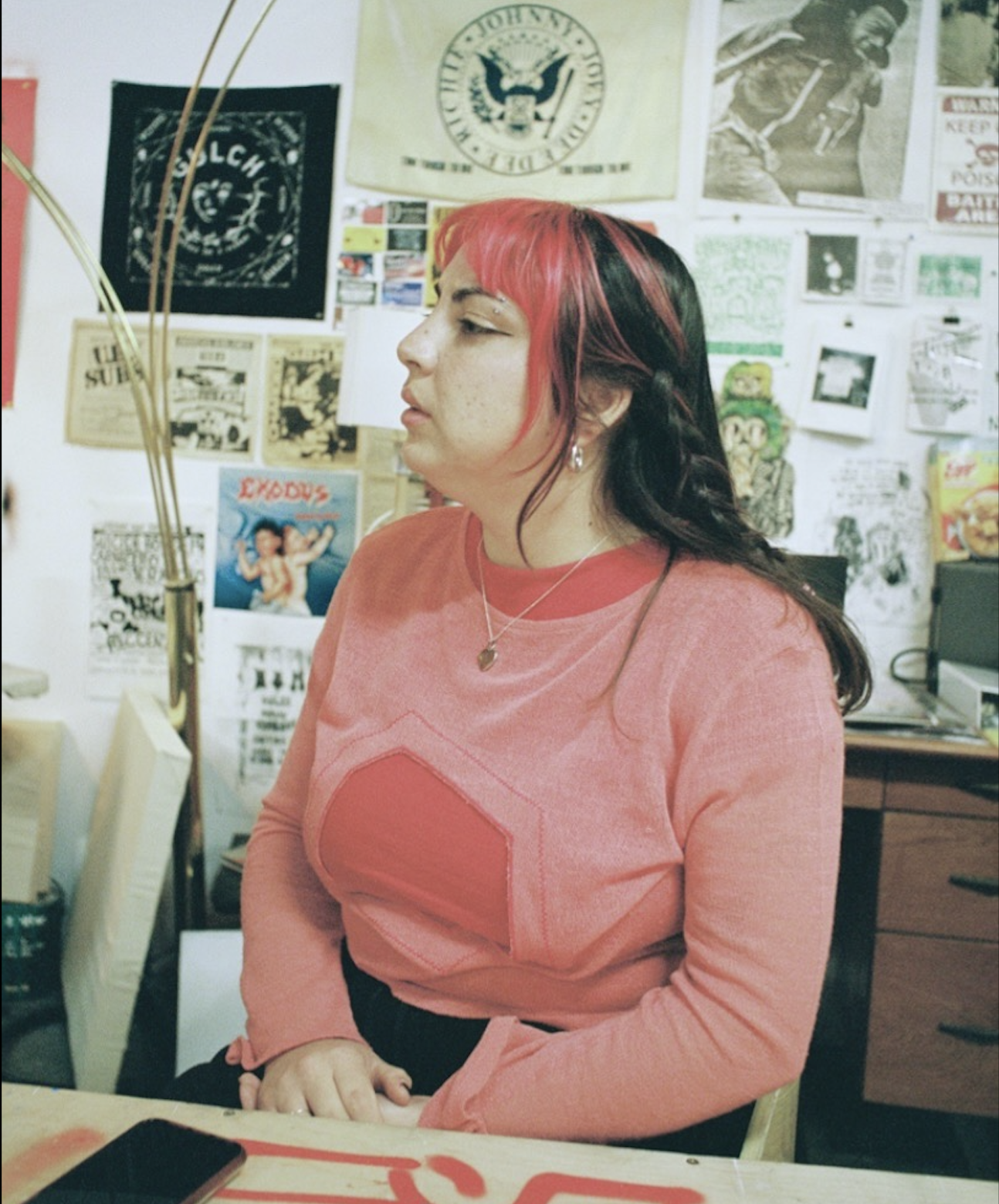
When Mario called his daughter, Citlalli, to tell her the news, she initially felt defeated. During those first few days of the wildfires, she’d sprung into action like many others across the county, connecting mutual aid distribution with established neighborhood networks, dropping off high-filtration masks and air purifiers to elders, loved ones with asthma, and tenants with rattling windows.
For a second, Citlalli—an organizer with the Echo Park local of the L.A. Tenants Union (disclosure: I am also a member/volunteer organizer with the L.A. Tenants Union alongside Citlalli)–forgot everything she knew about fighting evictions. She says she felt overwhelmed as she listened to her dad’s plans to start over once again.
“It took me like a day to realize, ‘Wait, I’m a part of the tenants union. I’m an organizer,’” she says. “‘Let’s fucking fight this.’ And then I had to agitate and mobilize my dad ‘cuz he was feeling very hopeless.”
“I was like, ‘What are you going to do if you have to close?’” she tells L.A. TACO. “‘It’s a recession, you’re almost 63. You’re just going to give away your whole restaurant where you’ve repaired everything and give it back to the landlord, and now he has a fully repaired place he can rent out?’ I was like, ‘Do you want to fight this?’”
At that week’s meeting of our LATU local, the bulk of the agenda focused on wildfire response, everything from organizing the distribution of supplies to demanding a county-wide rent freeze and eviction moratorium. When Citlalli shared that she needed support with her dad’s eviction, hands raised quickly to volunteer to do landlord research, start a fundraiser, and plan a phone campaign to deliver collective demands.
“At first, I was like, ‘Wait, this is a commercial tenant, and we usually only support housing tenants,’” Citlalli says. “But we’re constantly saying that this isn’t just about housing. It’s about leading dignified lives and caring for our communities, too. Then I felt like, okay, I’m not alone in this.”
Rather than move out of his restaurant, Mario is preparing to fight his eviction in court. According to Citlalli, both parties dispute the amount of rent owed based on varying interpretations of protections for commercial tenants and the lease terms. One dispute, for example, is over whether “maintenance” refers only to wear-and-tear repairs or includes the full buildout that was needed to pass initial health and code inspections.
“How could I just hand over 20 years of my life, a life of hard work and sacrifice?” he tells L.A. TACO, acknowledging that he'd like to continue growing Playa del Carmen. Raymond Fang, an attorney at Public Counsel and member of the firm’s small business team, is working on Mario’s eviction defense.
Since the launch of the public campaign to save Playa del Carmen, Mario has gained some new customers, including his daughter’s friends, strangers who heard about his fight on the news, and tenant union members currently organizing for protections for working people like Mario, who are struggling to recover from compounding economic crises.
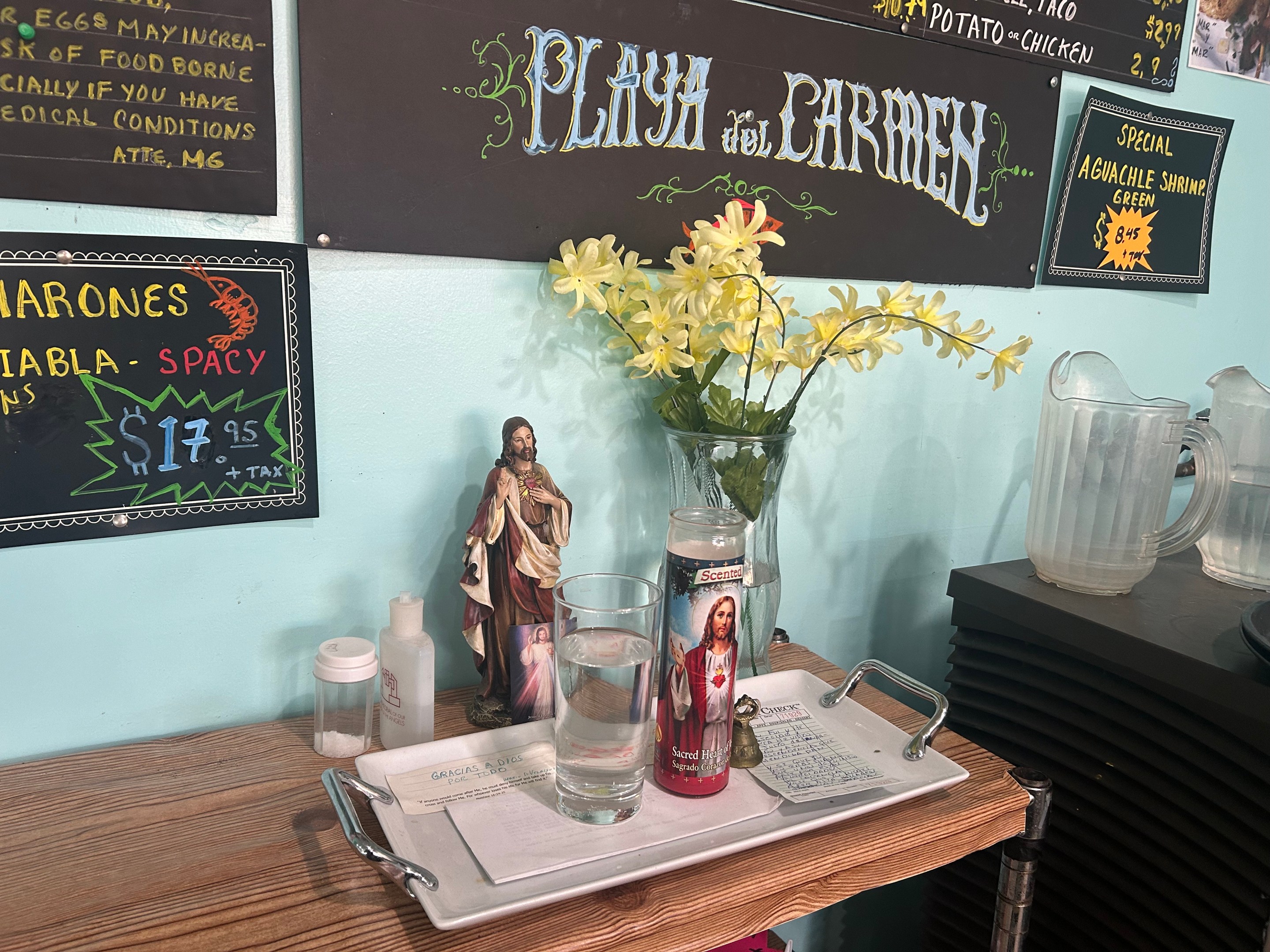
Back at his restaurant, which gazes at views of the San Gabriel mountains, framed L.A. Times features are proudly collaged along the walls, and there’s an altar behind the cash register.
There are also other altars hidden in every corner, with “AMOR,” “DINERO,” and “EXITO” written on bay leaves, along with fresh flowers and veladoras.
Everywhere you look, a statue or portrait of San Miguel Arcángel stands on the devil’s head. Mario says San Miguel—the champion of justice who leads the angels in the battle against evil—will bring him protection.
Playa Del Carmen ~ 950 E. Colorado Blvd. #202 Pasadena, CA 91106
L.A. TACO contacted Jack Nourafshan multiple times for comments but did not hear back.