An electrical box sits on a leisurely stretch of Traction Avenue in Downtown L.A.'s Arts District.
From the outside, the box is completely ordinary—so nondescript that it’s rendered nearly invisible to the naked eye. With the exception of a few stray graffiti tags, its exterior is gray, unmarked, and unremarkable.
Onlookers would likely be surprised to learn that the utility box is home to the smallest theater in Los Angeles, and possibly the world.
The 2-by-5-foot performance space known as “Electrical Box Theater” is guerilla artist S.c. MeRo’s latest street installation.
Based in Downtown, MeRo is known for her playful, 3D artworks that interact with the landscape of the city. Some of her past installations include a cafe for pigeons atop a Pershing Square parking sign, “Heron X-ING” signs in Skid Row, and a La Opinión-newspaper-stand-turned-aquarium in the Historic Core.
For the interior of the utility box installation, MeRo was inspired by early-20th-century Downtown Los Angeles and the historic theaters along Broadway Street. She aimed to recreate the feeling of going inside of the opulent, grandiose buildings built during the “golden age” of DTLA, such as the Biltmore and Hotel Alexandria, which are now too-often overlooked.
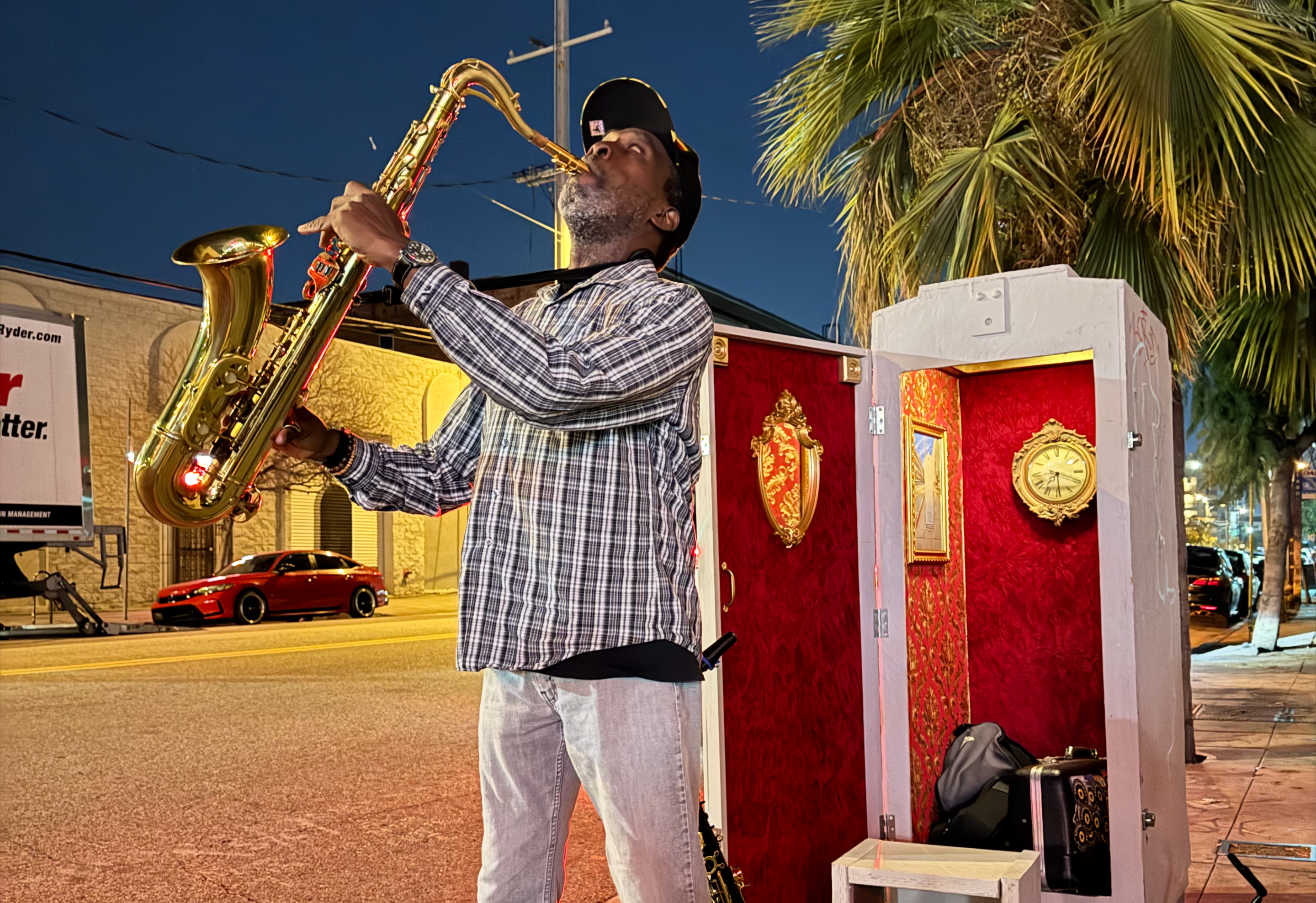
MeRo’s theater was built using simple, everyday materials, including painted plywood, linoleum, and wallpaper, mimicking crimson velvet walls and gilded gold accents.
By design, street installation art is vulnerable to the environments in which it exists and can be easily damaged by weather events, wear-and-tear from foot traffic, etc.
When MeRo arrives for the soft-opening in late-February, she touches up the exterior paint job after noticing it received water damage from recent storms. In terms of longevity, urban camouflage can at least offer a degree of protection from vandalism or city interference.
“Everybody seems to be walking right by it,” MeRo says of her latest installation. “The more you can make it blend in, and not in people’s face, the more likely it is to last.”
So far, the electrical box has been lightly tagged several times by locals. MeRo suspects this was done unknowingly by the graffitists, seemingly unaware that the box is an imposter.
“It’s also been buffed by the Business Improvement District,” she tells L.A. TACO. “So they are also participating in it unknowingly.”
As for the location, MeRo was drawn to the history of the Arts District as a cultural flashpoint for local artists.
“It’s actually a very historic location in the Arts District, Hewitt and Traction,” she says. “This is [why] it’s named the Arts District. In the ‘70s, ‘80s, ‘90s, artists actually lived here and they made a lot of art here.”
But the location is personally significant for the street artist as well.
“About five or six years ago, I built a giant mailbox and installed it here guerrilla-style over a street pole and it lasted for five years until it finally toppled over," she says. "So I knew that this box had a chance to stay for a little bit. The Arts District is usually pretty accepting of artwork here.”
Many of MeRo’s frequent collaborators on art installations, including her latest, live and work in the Arts District and Downtown Los Angeles.
Her close friend and fellow artist Wild Life, who she calls the “installation master,” helped engineer a battery-powered, glowing marquee made from cardboard. He installs it atop the electrical box with a drill and superglue while they prepare for performers to arrive.
Other collaborators include her friend Matt Blackwell, who constructed the wooden box, and artists Eddie Adolf and Stephen Seemayer, who assisted with the installation.
Even Sonoratown owners Jennifer Feltham and Teodoro Diaz-Rodriguez, who are best friends with MeRo, stop by to drop off a portable speaker system for the show.
S.c. MeRo’s aim with the “Electrical Box Theater” is to give local artists an accessible venue for live performances.
“I think we have enough galleries that celebrate two-dimensional wall artists,” she tells L.A. TACO. “We need more spaces that allow performance artists to come and perform on the street and just get creative.”
If the theater’s soft-opening show is any indicator, the installation has already succeeded in creating a space that doesn’t gate-keep artists from performing.
On an uncharacteristically chill evening in Los Angeles, a small sidewalk crowd forms to watch a variety show featuring rock ‘n’ roll, saxophone solos, and spoken-word poetry.
Jesse Easter, a musician and manager of the historic American Hotel, located across the street from the installation, is the show’s opener. As the sun sets, the longtime Arts District resident pulls out a Swiss Army knife to use as a guitar slide and plays a blues set inspired by "Mississippi" Fred McDowell.
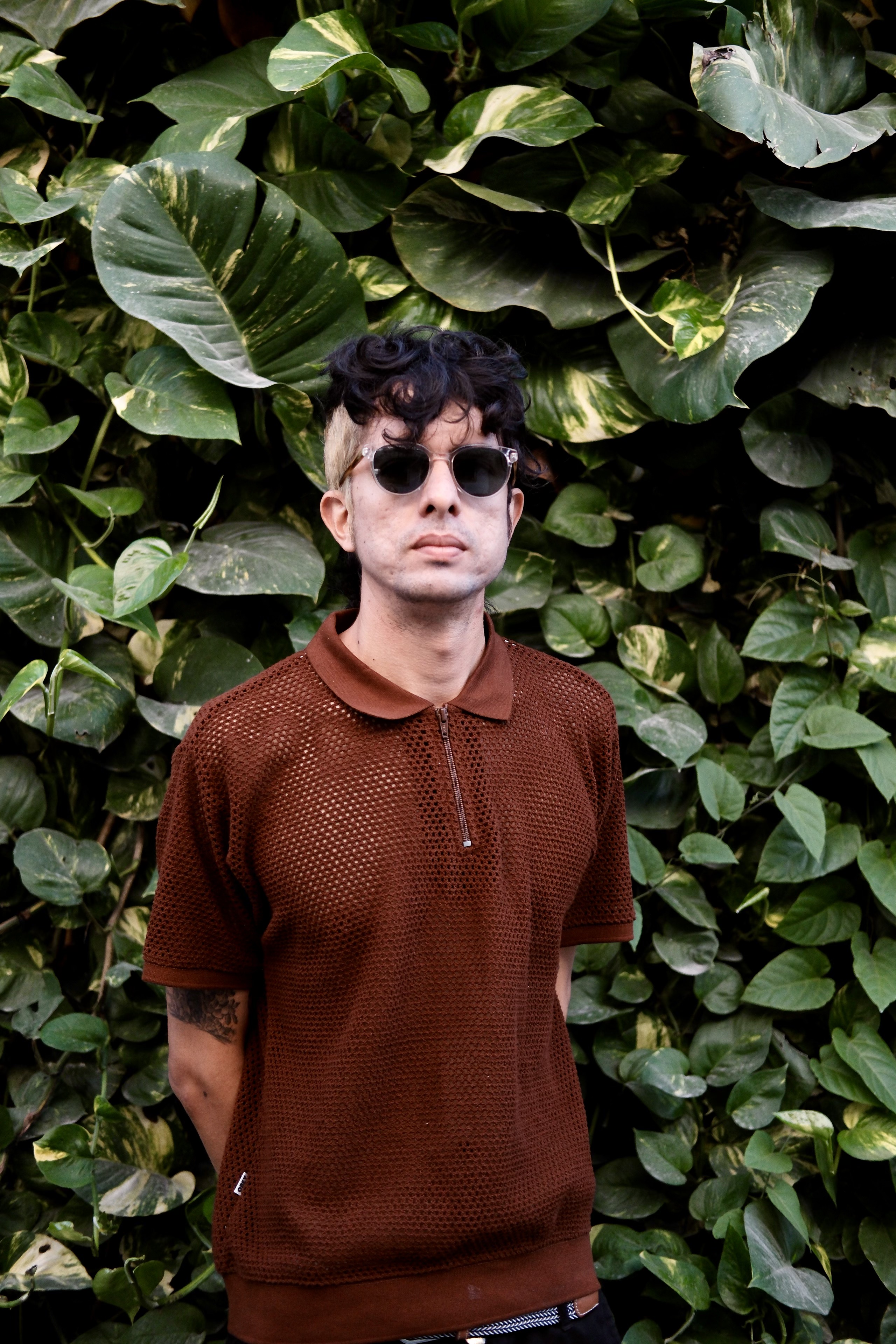
Easter is followed by Morgan Barajas, a visual artist and musician who sings and plays guitar under the name No More Cry Boy, and his brother Noah, a burgeoning poet who performs a set of haikus. Later in the evening, Myles Garland Jackson plays a rousing saxophone solo and Fannie Mayfield closes the show with a powerful spoken-word poem.
One artist, Mike Octane, decides to perform that night by sheer coincidence after he passed the installation while driving for Uber. For his live debut, he performs a dynamic spoken-word piece about Latino pride.
MeRo says she’s mostly been contacted by musicians and poets who want to book the space, but she’s also been contacted by podcasters, who plan to use it to record interviews with guests, and even clowns.
“This city’s full [of] so many amazing performance artists—experimental artists, avant-garde artists—that get overlooked, and this is our chance to collaborate on something together,” she says. “The possibilities are endless, really, what people can do.”
S.c. MeRo is currently booking performers for “Electrical Box Theater.” For more information and to learn how to participate in the project, you can DM her via Instagram.
800 block of Traction Avenue near Hewitt Street, Los Angeles, CA 90013