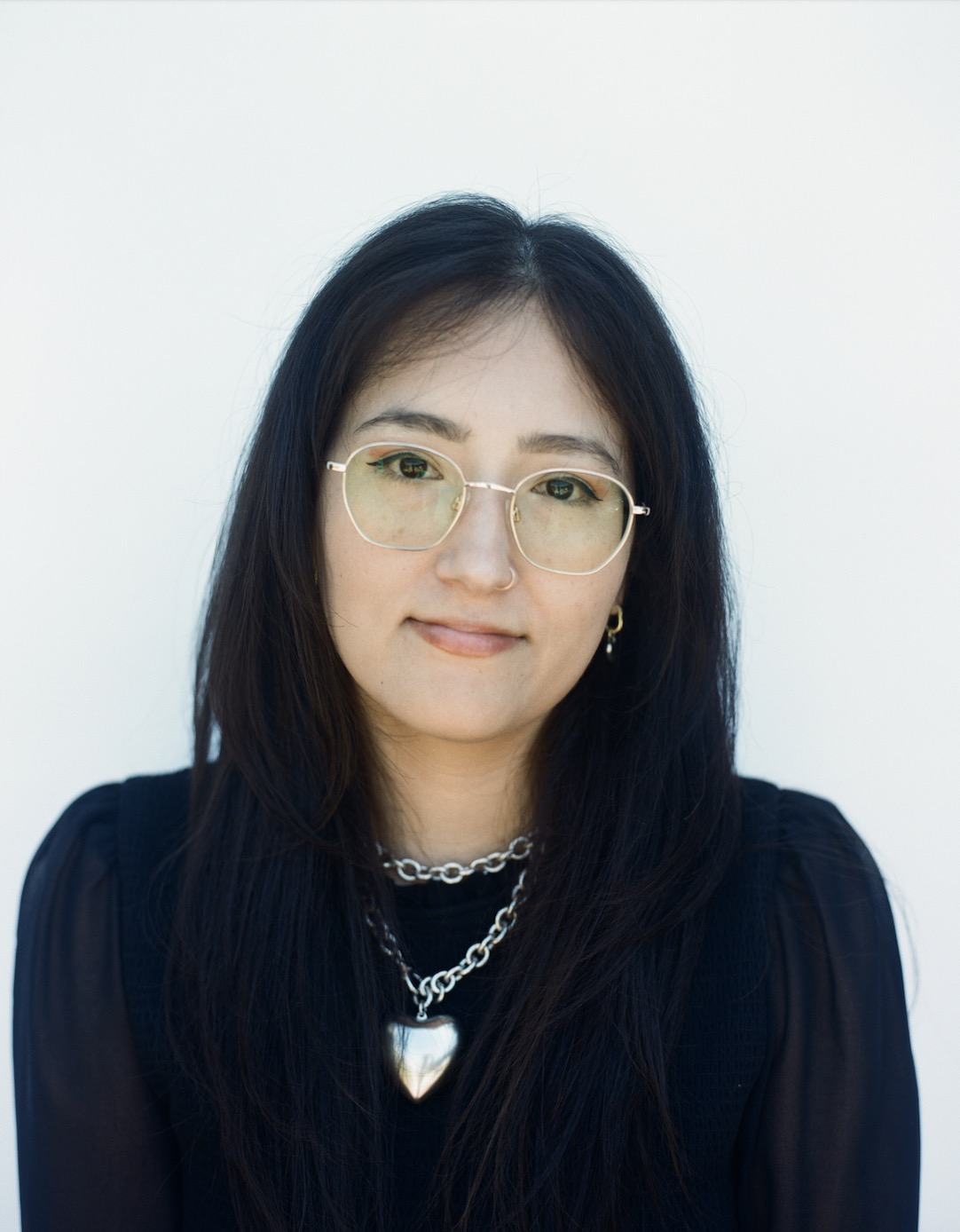
Award-winning taxidermist Paloma Strong was just 16 when she joined Occidental College’s Moore Lab of Zoology. She considers herself a “late-bloomer” within the taxidermy world considering so many professionals got their start in elementary school.
In June, she opened Strong Taxidermy, an independent business offering online classes, hosting guest artists, and selling pieces created by herself. Today, its headquarters are housed in the garage behind her parents’ home in Alhambra.
The Strong Taxidermy studio shares a space with folded beach chairs, party tables, and a couple of bikes. It’s an average garage, save for the freezer full of birds.
Strong has been practicing taxidermy for a decade now, and her work is displayed in prestigious institutions like the Smithsonian Museum of Natural History and the Santa Barbara Natural History Museum.
She and her partner, Laura Selig, operate the business together. Six years ago, when courting Strong, Selig texted her photos of pretty birds to get her attention.
“For a bird nerd like me, I mean that’s better than nudes,” Strong says.
“I helped with the ideas of social media and stuff like that. Like the Patreon and getting on YouTube and … trying to connect with the public in different ways. Because I feel like it is just an art that needs to be shared,” Selig says.
Selig used to work at the California Conservation Corps and LA Conservation Corps. She is now studying at Pasadena City College, and when she isn’t completing assignments, she helps manage Strong Taxidermy. Strong, who majored in biology, said that she is more STEM-oriented while Selig is more business-minded.
Avians are Strong’s specialty–her coworkers threw a party for her on Tuesday to celebrate the completion of her 100th bird at the bird lab, a male northern cardinal.
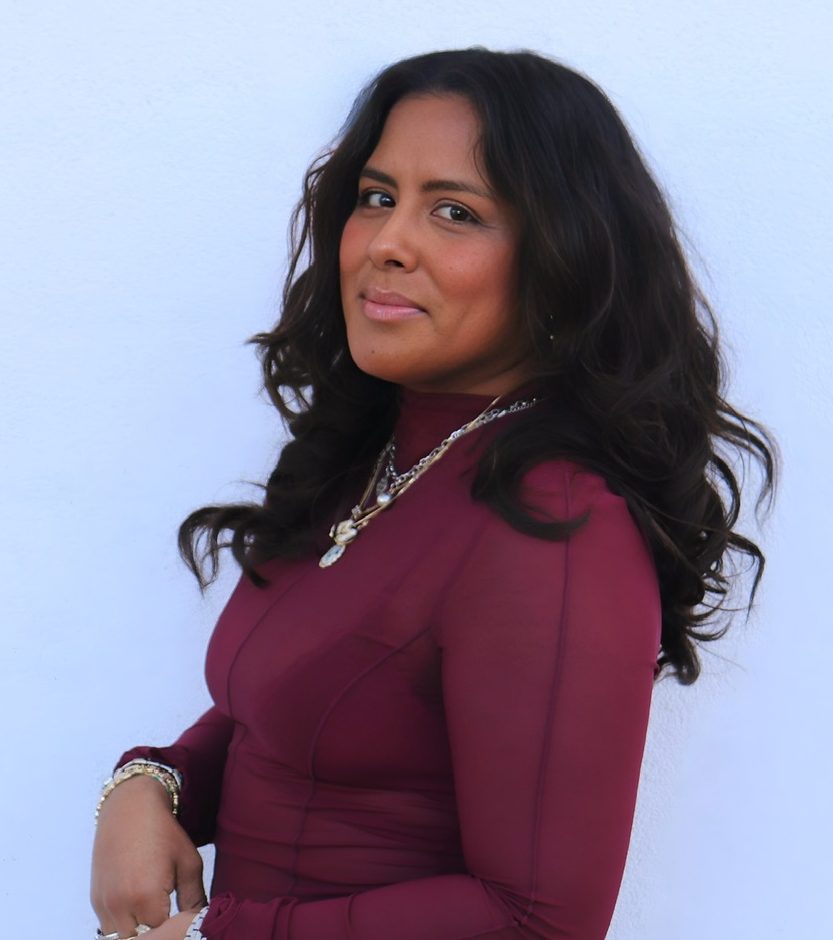
At the Moore Lab, Strong met Sparkle Juarez, a union costume designer, former L.A. Zoo educator, and fellow taxidermist. Plus, they have both trained under Allis Markham, a renowned museum taxidermist. Juarez is one of L.A.’s most successful and multi-skilled creatives. She even designed some of Beyoncé’s promo wear for the 2023 Renaissance World Tour.
If you’ve visited the Natural History Museum of Los Angeles County (NHM) before, you’ve probably seen Juarez’s work. She was part of the four-person team tasked with transforming the lion diorama in the NHM’s African Mammal Hall.
“[It] was redone where the male was no longer front and center, because that's not how lion prides exist. The males are definitely just on the sidelines, and the females run the pride,” Juarez says. “And we put two females at the front, and they're nuzzling each other's heads, and it's just like, so sweet, and it's something that you would never see in a private collection.”
Hanging out with living animals informed Sparkle’s work as a taxidermist, helping her mimic their behavior in her mounts. While working at the zoo, she learned how baby flamingos liked nipping at humans and how animals behaved differently when the seasons changed.
Juarez is able to do mammal taxidermy, but she prefers to work on birds. She gravitates to avians because each bird dictates its own final form. She has to consider how a bird may have moved while alive, according to its anatomy. Baby birds have paper-thin skin, and it takes an extremely gentle touch to maneuver a scalpel within their bodies.
“It feels like [the bird] kind of has a say in the process. And in general, any type of creative work that I'm doing, I love to allow for changes and differences and things happening in the journey,” Juarez says.
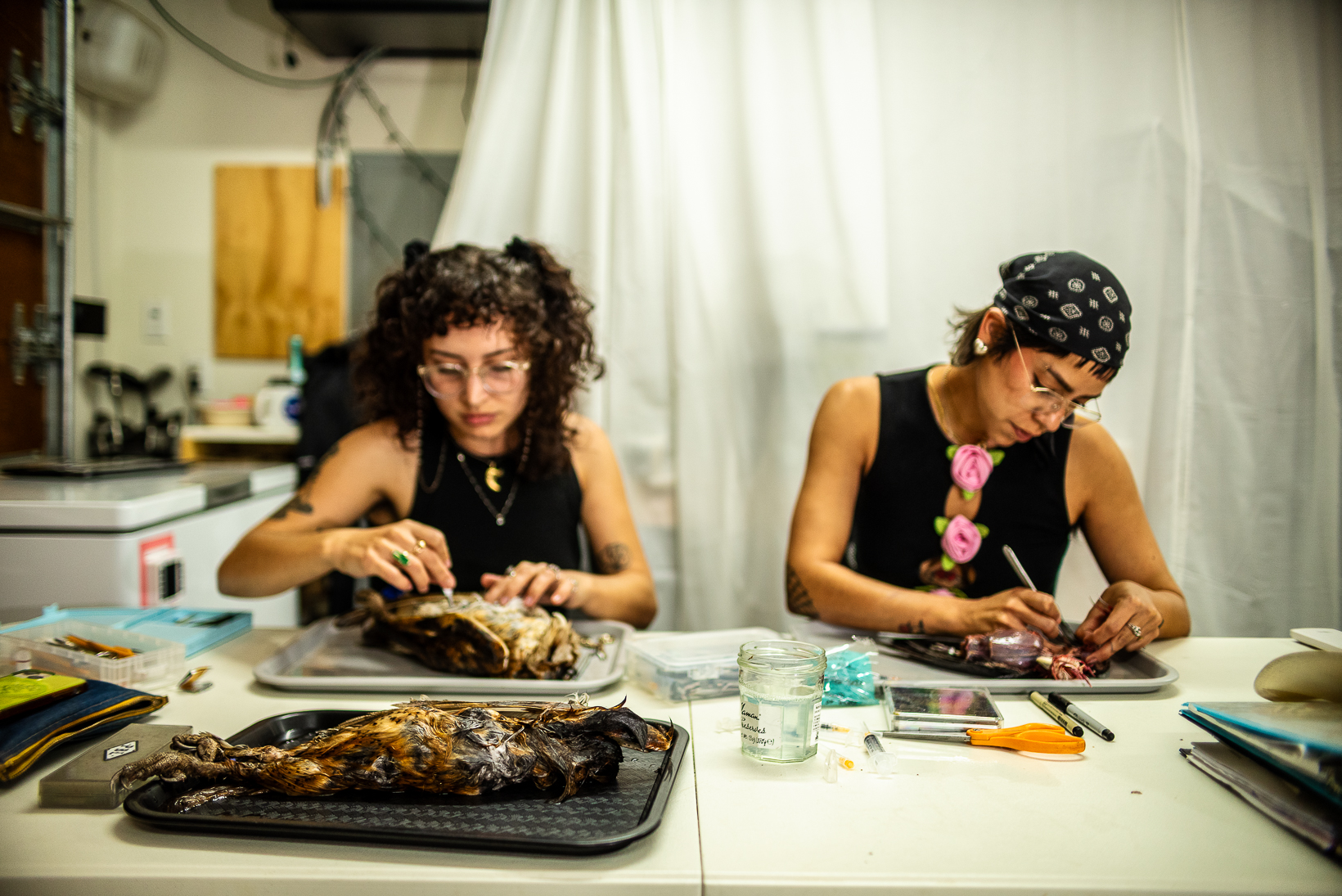
Juarez was working on a galah cockatoo, an obsidian and ruby-colored bird that measured about 12-inches long. While skinning the bird, she snipped a bit more than she meant to. Juarez and Strong were nonchalant and agreed that a couple of stitches would easily hide the mistake.
“But the nice thing is, with taxidermy, everything is smoke and mirrors. Everything is tricks. You can fix anything,” Juarez says.
Any animal part that can rot is replaced by taxidermists. Avian specialists start by skinning the bird. Strong said that she only keeps the original skin and a few bones for the final project.
“But you basically make this internal sculpture,” Strong says. “And you wire up the wings, you wire up the legs, you wire up the neck, but then it sits, it attaches to this internal structure. And what the structure is also depends on the taxidermist. So for me, I typically go between polyurethane foam and wood wool. … But you just make it some kind of sculpture, and then you put the skin back over it. Now, the brain gets filled with clay. You have fake eyes and the skin, you want to make sure it's still wet and movable, but that's when you put it all together.”
While the bird’s skin is still wet, Strong poses the bird, ensuring everything is symmetrical, aligns with her reference photo, and is up to her client’s standards.
“I use a lot of these skills in my costume work, and because it taught me different ways of making … ,” Juarez says. “I'm like, ‘Okay, I can do more fun, different things when it comes to costuming,’ but I will never put a bird head on a mammal body. I will never put wings on something that doesn't have wings. I just–I want to honor their lives.”
Taxidermists specializing in game often pose their work in a style that emphasizes the most dangerous parts of an animal. Juarez said that a lot of mammals are posed with a sense of aggression–whether it’s a bear with unhinged jaws or a leering tiger ready to pounce.
“Taxidermy is not just about creating a relationship with an animal by honoring their life, it is about developing a connection with the person who sees your final piece. Maybe it’s a kid that will be inspired to carry on the practice of taxidermy,” Juarez says.
Selig doesn't consider herself a taxidermist and instead shows her advocacy for L.A.'s flora and fauna through her research on the local coyote population and a hardcore vendetta against invasive mustard seeds. When she is out in the city, she doesn’t hesitate to pull mustard plants from the ground to “keep the community clean and increase L.A.’s native plant population.”
“Most people just aren't aware. Like, it's just, we're so disconnected with plants in general. Plants, you can't really form a relationship with the same way [as animals]. So somebody's got to talk about them and speak up about them,” Selig says.
To acquire specimens, taxidermists must have specific permits that correlate with the animals they work on. Strong has a copy of her Migratory Bird Permit issued by the U.S. Fish and Wildlife Services that she keeps in a binder in the garage. The federal avian laws in the U.S. are infamously strict and difficult to remain up-to-date on.
A slew of regulations exist around the taxidermy industry. A quick rundown: 1) No, you cannot pick up roadkill for a taxidermy project in California. 2) Permit laws differentiate from state to state, and California is known for being strict. 3) Breaking these laws in California can lead to fines worth thousands of dollars and even jail time.
Juarez and Strong bonded over their shared affection for birds and the fact that they belong to the same generation of taxidermists.
“A lot of the older taxidermists are going to be like older, older White guys who are wonderful. And the thing is they're not closed-minded people. They're people who don't really care where you come from, who you are, but if you share the passion for nature and science and taxidermy, they'll teach you,” Strong says. “They're just like, ‘Look, it's none of my business. If you want to skin a deer with me, if you want to help do this.’ They don't care. They just want more people, and they don't want to be the last taxidermists.”
When Strong met René Corado, a Guatemalan zoologist and the collections manager of the Western Foundation of Vertebrate Zoology, she asked to see his work. Corado showed her a Resplendent Quetzal he completed, the national bird of his home country. After noticing a decades-old, flat quetzal skin once used for scientific research, Corado transformed it into a mount because he wanted to represent a piece of Guatemala within the foundation’s collection.
Women like Strong and Juarez will eventually become the next generation’s mentors, sharing their tricks with young people to keep this tradition alive.
The last in-house taxidermist in America works at the NHM. Strong said there will likely be no others after him due to general museum budget cuts. In the Moore Lab, avians from the 1800s and 2020s coexist, forever cared for by the lab staff as long as funding allows.
“The best part about taxidermy is, you know, [I] put it together, but it's gonna outlive me. It's dead, but it'll last longer than any of us,” Strong says.