

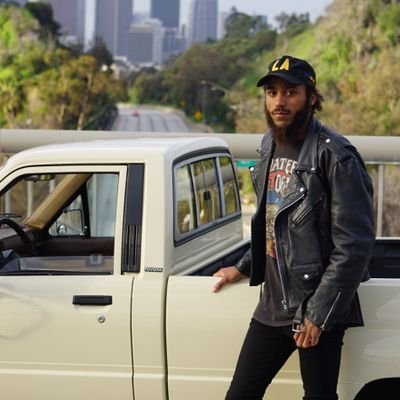
Welcome to L.A. TACO’s weekly Investigations Newsletter. I’m Lexis-Olivier Ray, the Head of Investigations for L.A. TACO.
Earlier this week, I came across a viral TikTok video from a researcher who had a lot to say about protests.
“There’s zero evidence that demonstrations change either the public's opinion or government policy,” said Sarah Stein Lubrano.
“Zero.”
According to Lubrano, the only exception in recent years has been the Black Lives Matter protests after George Floyd was murdered in 2020. But even then, the impact that those protests had on the public’s perception of the police was only temporary, Lubrano argues.
“The closest thing that you might see is what happened with Black Lives Matter in the United States, where there was a temporary shift in public opinion; it lasted about two years, and it is back to the baseline,” she explained.
“And in some ways, even worse, what you really see is that basically white people in the United States are more in favor of the police and other people are a little bit less in favor of the police, and the overall numbers are the same,” she added.
“I’m not saying don’t protest, but I am saying they are not a mechanism for persuasion,” Lubrano claimed.
Lubrano expands on this argument in Don’t Talk About Politics: How to Change 21st-Century Minds. The 280+ page book examines the impacts of political discourse beyond protests. In it, Lubrano argues that protesting, debating, and public discourse don’t typically lead people to change their beliefs or affect government policy.
Lubrano admits that people do of course change their opinions about things, sometimes profoundly, “Just not for the reasons we might instinctively imagine.”
Life experiences, opportunities, and social interactions have a bigger impact on people’s beliefs, according to Lubrano.
She cites a study on gay marriage as an example. The study showed that people quickly became more accepting of homosexuality and gay marriage when they found out their friends and family were gay.
“Exposure at a personal level . . . seems to reduce our sense that those different from us are a threat,” Lubrano wrote.
Lubrano’s work focuses heavily on "cognitive dissonance,” an often misunderstood term that refers to our response to information that challenges our preexisting beliefs. In a political sense, Lubrano believes that cognitive dissonance is at the core of why simply talking about and debating issues doesn’t have much of an impact on people’s beliefs.
As an example, Lubrano notes how prior to Trump being re-elected in 2024, the vast majority of republican voters believed that a convicted felon should not be president of the United States. But when Trump became a convicted felon, republican voters just changed their minds about the issue, and now most republican voters have no problem with a convicted felon running our country.
“In short, we rationalize what we need to in order to hold on to the beliefs that let us keep operating in the world,” Lubrano wrote. Which for Trump voters was the idea that Trump would improve their lives.

On a local level, I think the Black Lives Matter movement clearly had an impact on both the public’s opinion about policing and government policy.
A couple of months after George Floyd was murdered, the Los Angeles Police Department’s (LAPD) budget was cut. In the subsequent years, a number of reforms were passed. And Los Angeles County got its first “progressive” district attorney.
But as Lubrano points out, public perception of policing in Los Angeles seems to have returned to its pre-protest state. The LAPD’s budget continues to grow; last year there were 46 LAPD shootings (compared to 27 in 2020), and Los Angeles voters voted for a mayor who promised to hire more police officers (and she might be reelected).
“I wouldn't write off protests led by Mahatma Gandhi, Martin Luther King Jr., Rosa Parks, Nelson Mandela, or any other heroes of humanity."
Adam Rose, deputy director of advocacy for Freedom of the Press Foundation (FPF)
So was it the protests that spurred the change, or Derek Chauvin's murder of Floyd, or a combination of multiple factors? Lubrano admits that it’s difficult to connect a protest movement to a specific outcome.
“Academic studies of protests will view them through the lens of peace parades and rallies,” Ricci Sergienko tells me. Sergienko was one of the most prominent organizers in L.A. during the Black Lives Matter protests in 2020. He’s now a civil rights attorney.
“Instead we need to look at how disruptive they were,” he says. “Did they propel people into further action such as strikes, boycotts, more direct action?” he asks.
Sergienko argues that “protests are a tactic that should be a part of a broader movement strategy” and that Lubrano’s video “obscures the lengths the government will go to crush protests and target organizers.”
According to Sergienko, the George Floyd movement didn’t fail because people weren’t persuasive enough; it failed because organizers lacked the “organizational infrastructure to build a mass movement,” the state “clamped down hard AF,” and because of “co-option and counterinsurgency.”
“So the statement that it has zero impact is actually false both objectively and from my own political studies as someone who has been active in the streets and following modern movements for nearly two decades,” he concludes.
Several people I spoke to accused Lubrano of boiling a complex topic down to an intentionally controversial clip to help her sell more copies of her book (it worked! I bought a digital copy after watching the video).
“She’s trying to sell a book by being controversial and via clipping,” one person wrote me on Instagram.
But a few people agreed that recent protests have been ineffective.

“From my POV, going to a protest will fundamentally change a person's life,” says Erick Huerta, a longtime organizer and OG L.A. TACO contributor. “So many friends, comrades, and leaders in movement spaces can trace their trajectory to attending a protest as a young person. It exposes you to so much of the world, especially when you are given a narrow view of the world at school and at home.”
Huerta describes protesting as a “rite of passage.”
“If protesting wasn't as effective, as home girl states, then why is there a long [history] of state forces brutalizing and killing protesters?” he questions.
“I'm skeptical of claims about the effectiveness of protests (effective or ineffective!) and think it boils down to both context and the goals of a protest,” says Adam Rose, the deputy director of advocacy for Freedom of the Press Foundation (FPF). Rose is not a sociologist or a political scientist, but through his work with FPF and the Los Angeles Press Club, he’s monitored dozens of protests across the country and collected data on press rights violations.
“Certainly, protests themselves are a powerful convening of people in movements that establish connections and means of coordination,” he says. “That alone can lead to impact.”
Rose highlighted a list of protest movements that he says had a significant impact on the “U.S. revolution,” including the women’s suffrage movement, civil rights movement, and the farm workers movement.
“I wouldn't write off protests led by Mahatma Gandhi, Martin Luther King Jr., Rosa Parks, Nelson Mandela, or any other heroes of humanity,” he adds.
A few people that I spoke to, however, say they agree with Lubrano—at least partially.
“I agree that most protests fail,” William Gude tells me. Gude is a cop-watcher who goes by Film The Police L.A. on social media. “[They] Often end up getting off message, piss off or alienate natural allies, get hijacked by people living out their fantasies, and degenerate into straight goofiness.”
“But I've seen them work,” he continues.
“My Scientology protests ended up leading to their main recruiting location in the world closing for over a year. And the awareness it brought, especially to young people, has hurt Scientology in a bad way. They've seen their money cut and power in local government greatly diminished.”
“In regards to [Lubrano’s] findings . . . I realized this a long, long time ago,” Zxaye Jah-Reign tells me.
Jah-Reign was heavily involved in the 2020 George Floyd protests and the initial anti-ICE protests last year, but he eventually distanced himself from the anti-fascist movement.
“Personally I think that people are far too passive,” he tells me. “The reason why these imperialists are able to continue to encroach upon our rights is predominantly [that] they are not being resisted, right?”
Jah-Reign believes that people generally don’t resist authority because they fear retaliation and they’re “far too comfortable.”
“That's what it is. People don't want to live uncomfortably,” he says. “People don't want to live without that sense of certainty, right, and that is the reason why I have stayed so far away from the protesting. Because I'm not willing to compromise my life and my safety for people who aren't willing to go as far as I will.”
“The truth of the matter is, if you aren't willing to get hit in the face, if you aren't willing to have bruises on your body, if you aren't willing to carry the dead body of one of your comrades over to the other side of the barracks, or maybe possibly have to leave it in the street in order to evacuate everybody else that is still living,” he says. “If you are not in that mindset, then the worst things that you can imagine one day will happen right here on your home soil, simply because collateral damage is not something that we're willing to mitigate.”
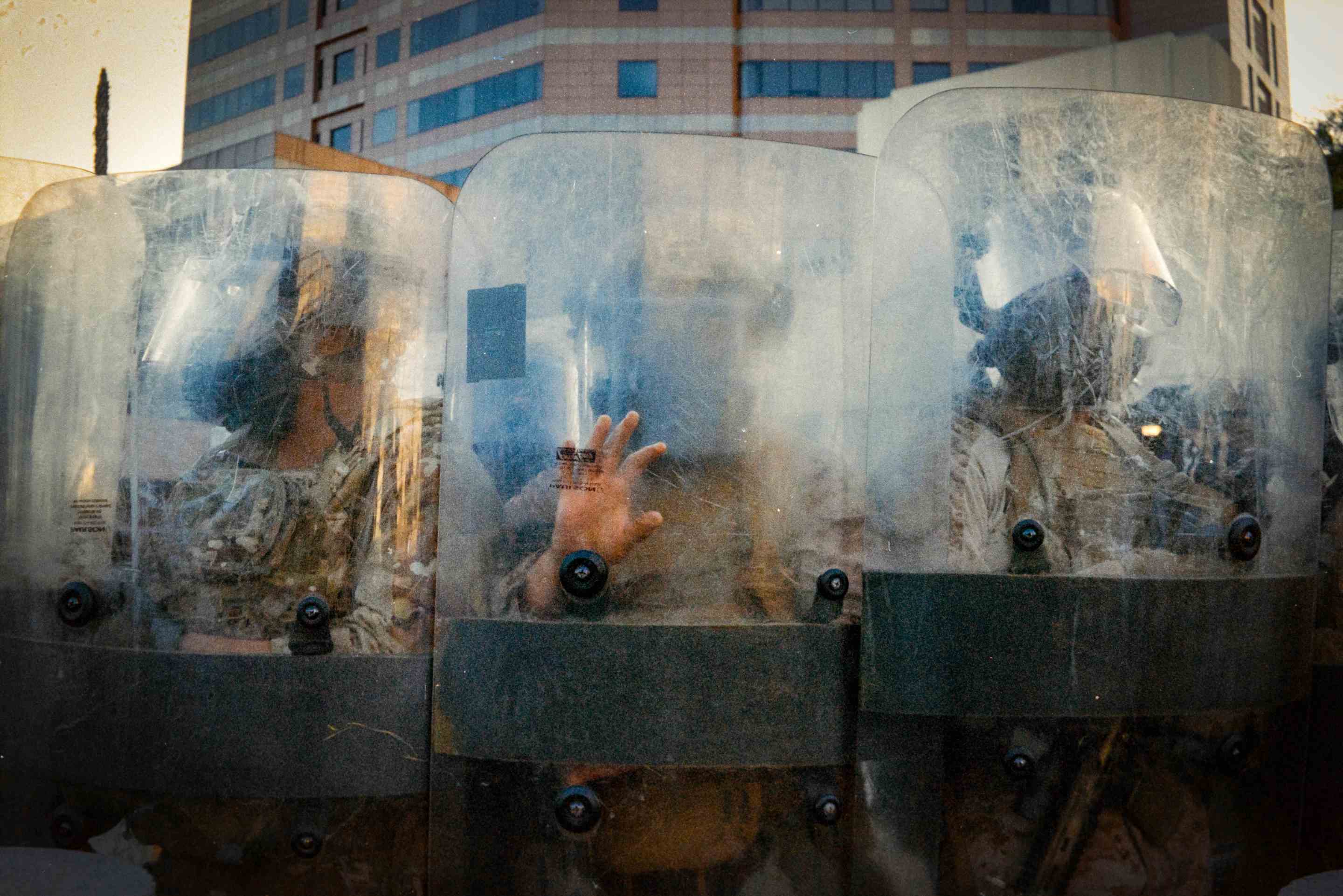
As someone who has been shot by police with less-lethals three times, detained and threatened with arrest multiple times—all just within the last year—I’m not sure I would be putting my safety and freedom on the line if I thought protests were pointless. One of the reforms that came out of the George Floyd protests was Penal Code 409.7, the state law that bans police from intentionally assaulting, interfering with, or obstructing journalists covering civil unrest. It also limits the police’s ability to close off areas to journalists after dispersal orders have been called. Those limitations didn’t exist back in 2020.
A group of LAPD officers just broke my camera mic, tackled me to the ground and beat me with their batons, after I identified myself as a journalist multiple times. @LATACO pic.twitter.com/2VaB4sq8IJ
— Lexis-Olivier Ray (@ShotOn35mm) October 28, 2020
I played an indirect role in helping get that legislation passed. Back in October of 2020, when the city erupted from darkness after the Dodgers won the World Series, a group of LAPD officers charged at me while I was covering the celebrations in Downtown. The officers pushed me into a car that was in the middle of an intersection and forced me to the ground while shouting at me and the driver. I remember fearing that the driver was going to run over me. “I’m press!” I shouted as the furious officers wielding batons towered over me. Eventually the officers backed off, and I continued covering the celebrations, bloody and bruised. Then four months later, the City Attorney’s Office charged me, and only me, with “failure to disperse.” At the time, PC 409.7 wasn’t on the books. And an earlier initiative to amend the law had failed. But experiences like mine made lawmakers reconsider. And while the police only sometimes follow the law, I think journalists are safer with it than without it.
From a journalist’s perspective, I’ve noticed a shift in the anti-ICE protests that have persisted for a little more than a year now. Last year there were tens of thousands of people in the streets around this time of year. Last Sunday, my colleague Izzy Ramirez covered a protest at the Metropolitan Detention Center that only attracted around 100 people, he told me. During the protest, people played games like “pin a ‘stache on a nazi,” and later in the evening they hosted a dance party, he said. A protester told Izzy that “they wanted to center joy.”
In recent weeks I’ve talked to numerous journalists who are taking a break from covering protests or rethinking their coverage. I myself sat out the last two weeks of protests for the first time since the federal immigration raids began last year. Frankly, I’m tired of being shot, inhaling tear gas, and being detained. And in some ways, protests have become predictable. The juice isn’t worth the squeeze for me right now. But you can bet I’ll be back out there when the time comes.
Was this newsletter forwarded to you? If you’d like to receive it weekly, sign up for an L.A. TACO membership here, head over to the “My Account” section, click on “Newsletters,” and make sure the “Investigations Newsletter” is toggled on.


