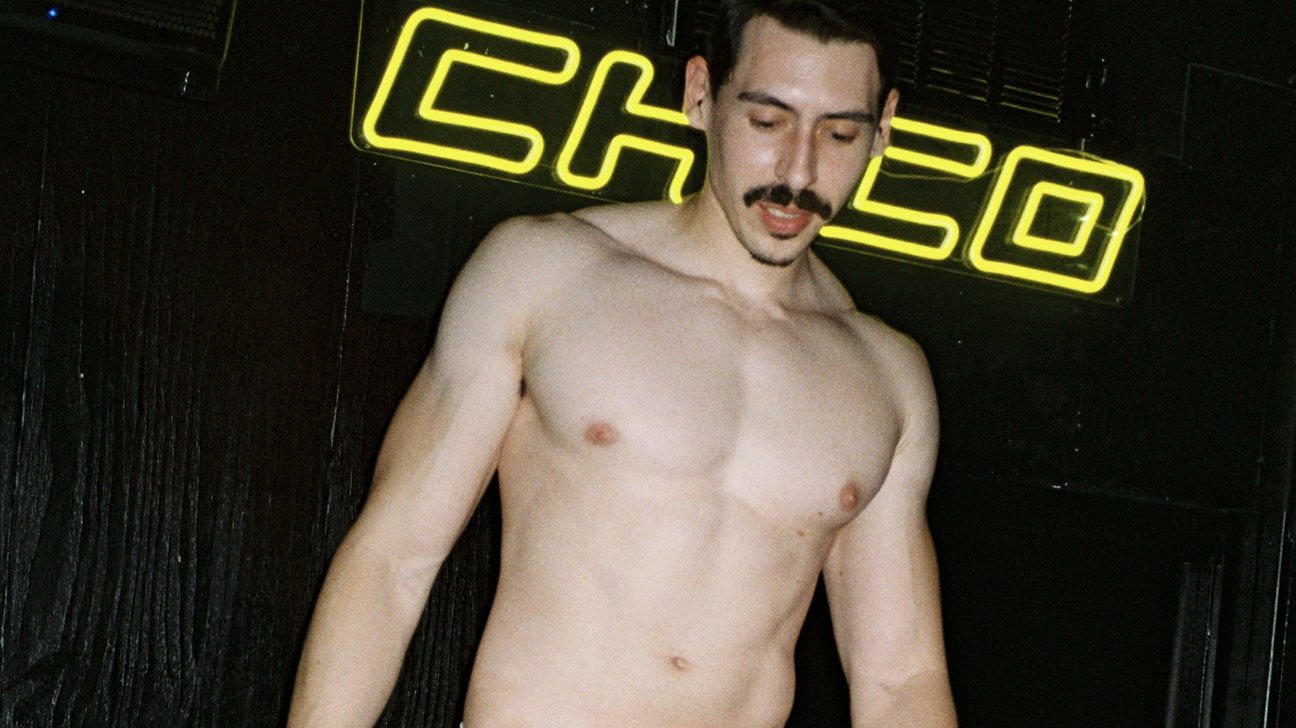
A shimmering disco ball hangs in the middle of the dance floor. It twinkles above the go-go boys as they thrust and dance on the platforms located directly next to the stage. A bright neon “Chico” sign hangs above the main platform. The DJ is in the room off to the left, attached directly to the main area. The room is scattered with tables and seating, a bit more relaxed than the bar and dance floor area.
In the back of that room is a booth selling the famous clapper fans to keep the boys, girls, and dolls cool as they sweat it out on the floor. Mark, one of the owners of XFridays and a dancer, worked his way through the crowd, greeting everyone with a smile before he hit the stage to dance. The crowd was diverse, small but lively, and somehow it felt like everyone knew each other.
Chants of joy, brown bodies, and musica in Español, hip-hop, and pop hits poured out of the petite space into the parking lot unexpectedly situated next to a flower shop. East of East Los Angeles, in a small shopping mall, is the quaint but famously iconic bar amongst the locals, Chico. PBS SoCal has even honored it as the “‘Best Latino Gay Bar’ in Montebello.”
“It’s always a good time,” says 34-year-old Jessica Salinas, who has been coming to Chico since 2017. For her, other clubs are too far. She admits the space may be a bit tiny, but “it’s important to have a small place for the community, too.”
Since Chico first opened its doors in 1999, the space on the corner of Beverly and Garfield has hosted iconic events like the punk-driven but controversial “Club sCum” and the super hot “XFridays,” which features go-go dancing (and took place the night this article was written).
Chico is unlike other gay bars—with its more rugged appeal, underground vibe, and, dare I say, a bit of a macho flair. Yet behind the (literal) black door of Chico is a central theme of community and, for many of the clientele, a sense of familia.
Lucas Hilderbrand, a professor of film and media studies at the University of California, Irvine, provides an extensive history of gay bars and demonstrates how they function as a vehicle for culture, politics, and creating a sense of community in his book ”The Bars Are Ours: Histories and Cultures of Gay Bars in America, 1960 and After.”
Chico aimed to separate itself from the homonormative version of what gay nightlife looked like at a time when LGBTQIA+ representation was gaining mainstream acceptance, states an insert from Hilderbrand on LGBT Prime. Chico has always tried to maintain that “homegrown” feel on the Eastside since its inauguration 20-plus years ago.
Their debut ad, according to Hilderbrand, featured a tagline that read, “the new spot for mi gente,” a call-out to the Chicanxs that lived on the Eastside. For countless customers, this appeal is what kept, and keeps, them coming back as loyal clientele of this lowkey joint.
“It’s really good for the community, and it gives me a place to dress [up] and come and hang out and meet people, interact with different people, and especially interact with people that are in the same realm as I am; like dressing up and everything so it’s very [much] a safe space to be able to enjoy and be yourself,” says Elena Carvhaal, a 56-year-old communication technician who has been a patron of Chico for three years.
Carvhaal says the community has helped her feel more comfortable living as her authentic self and credits feeling seen and welcomed to those at the bar.
“The music. The people that come here,” says Carvhaal, “that’s what makes this place, and everyone is more humble, everyone is more open, everyone’s more kind and more heartwarming.”
For 67-year-old Priscilla Moreno, who has been coming to Chico for more than 30 years, this closing feels personal. Moreno used to visit with her late gay brother but fell in love with the friendly people.
For 67-year-old Priscilla Moreno, who has been coming to Chico for more than 30 years, this closing feels personal. Moreno used to visit with her late gay brother but fell in love with the friendly people.
“Even if Chico would have [made it] further, I still would have gone [but] since it’s close, it’s my second home,” Moreno admits as her voice trembles and tears begin to swell. “I’m going to be very sad about it.”
Like home, she has made connections that have now become important pillars of friendship in her life, like Carvhaal. The two have been friends for over a year, a testament to the bonding relationships created at Chico. Her fondest memory, however, is “the dancers, the performers, everything!”
Creating alternative forms of queer, safe spaces has been pivotal to the LGBTQIA+ community since Stonewall, the Harlem Renaissance, and beyond.
Hilderbrand writes, “As Dick Leitsch of the Mattachine Society reflected, ‘The Stonewall became ‘home’ to these kids. When it was raided, they fought for it. That, and the fact that they had nothing to lose other than the most tolerant and broadminded gay place in town, explains why the Stonewall riots were begun, led, and spearheaded by the ‘queens.’”
For the Eastside, Chico remains one of the last few gay bars. While West Hollywood, North Hollywood, Long Beach, and more offer options for a night out, it may not feel the same for BIPOC.
Jose Pacheco, 35, and Paul Chino, 32, are visiting Chico’s XFridays for the first time, and sadly the last time. Pacheco currently resides in Riverside but has been invited to Chico on numerous occasions before finally deciding to make the trek with his friend, Chino.
“It’s a bummer [for me] because it’s my only night here, but I see why it’s special for a lot of people,” says Pacheco.
When asked, it was hard for him to think of another gay or LGBTQIA+ Latinx space in Montebello or on the Eastside.
“It’s a bummer that they’re closing because I know a lot of people like going here, and it’s a safe space for them and it’s a space for them to be themselves, create community, build community,” says Pacheco.
Spaces like Chico offer a haven for Latinxs who may not feel the same sense of community that they do when visiting other areas of the city.
“I feel like there needs to be more places out of WeHo and more places like in surrounding areas; it’s kind of sad that there’s places like this closing,” says Chino. “I feel like these are the types of bars that you meet more different communities that are outside of . . . I don’t want to say WeHo is gentrified, but it feels like that.”
“I feel like there needs to be more places out of WeHo and more places like in surrounding areas; it’s kind of sad that there’s places like [Chico] closing . . . I don’t want to say WeHo is gentrified, but it feels like that," says Chino.
Chino is a straight man but is an ally to the community he shares with friends.
“Representation matters even in bars and clubs and everything like that, so you feel like you’re in more; even if you are not gay, you still see people that look like you at least, and I feel like that’s very much needed,” Chino states.
Even with this sense of community from patrons, many neighborhood bars in big cities struggle to compete with “gayborhood bars,” a stark comparison to the closure of this long-standing space. Data based on a 2023 census of gay bars and clubs by sociologist and Oberlin College professor Greggor Mattson also found that just “6.6% of queer bars catered to POC.”
Pacheco feels that while these spaces are scarce, people seem to be hungry for these types of spaces.
“Especially now where everything, especially in the Latino community it’s heavy, it’s a state of oppression and we speak about community, and I think the community is showing up in great ways,” says Pachecho, “but I think having these spaces are important where we want to dance, where we want to commune, where we want to have a drink, where we want to invite our friends.”
Shared interests, ideals, history, struggles, and so much more help create the sense of a community. Each space has its own story. For Chico, its legacy seems to be one of friendships, camaraderie, laughter, dancing, and, as Moreno jokingly stated, “the [hot] boys.”
New owner Mario Trujillo (alongside his husband and investors) has confirmed a grand reopening within a month or two. He says he made sure to have the blessing of one of the now-former owners, Marty Sokol, and is honored to incorporate a new but familiar aspect to the new name: “Muevelo at Chico.”
“We both [Sokol and himself] agree that Chico is not ending,” says Trujillo. “This is a new chapter for Chico . . . I’m grateful to Marty for him to have created [Chico and Cobra] for us.”
Trujillo is Downey's first openly gay mayor, having served from 2023-2024, and an advocate for the LGBTQIA+ community. He began Muevelo in Downey with his husband and spearheaded Downey’s first Pride celebration.
“Over time, especially with the loss of Circus and Arena [nightclubs], I defined my desire to own a dance club and made it specific: a gay Latino dance club,” Trujillo says.
While Muevelo in Downey isn’t going anywhere anytime soon, Trujillo admits he wanted a more permanent space. That’s when Sokol’s representatives reached out to him and his husband to discuss selling Chico.
“I see it as a merger,” says Trujillo, “and that’s why, as a member of the community, I want to continue the iconic legacy of Chico; I’ve been a client of Chico, I like Chico, and in many ways we developed Muevelo to be like a Chico, like an Arena and Circus—a smaller version.”
Trujillo understands the importance of these safe spaces for the community. He wants to keep the heart and soul of Chico but elevate it. His hopes for Muevelo at Chico? For it to be a space for all to come and hang out after work, a sporting event, host their own community events, or just escape from the mundane.
“We are in this for the long run,” Trujillo says emotionally over the phone. “There were no goodbye parties; Marty did not want to have a goodbye party because this is not a goodbye. This is just a reimagining. It’s Chico 2.0, and I am honored that Marty allowed Muevelo, that name, to be next to his. Yeah, it’s got me emotional, man, because we started as a hobby and never would have imagined.”
What will the space look like? How will the crowd be and feel? Only time will tell come autumn, but one thing is certain to its loyal customers, or familia: It may not be the Chico they came to know and love, but it’ll continue to be a home away from home para todos.