
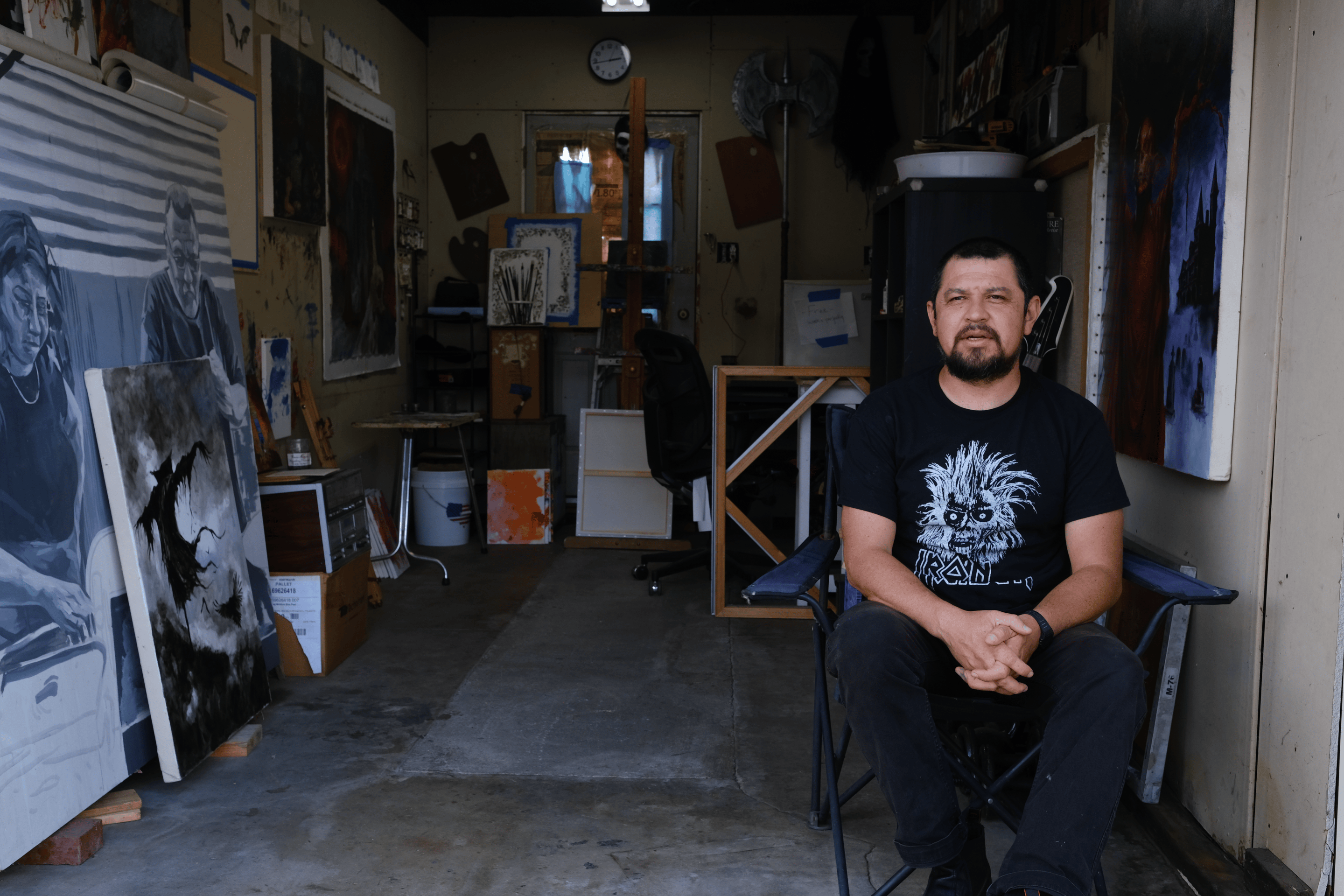
Artist Guillermo “Memo” Millán’s first commissions featured various X-Men and other superhero characters. He’d draw them for his classmates at La Merced Elementary School to display proudly on their binders in exchange for a handful of dollar bills.
When the 42-year-old paints now, in the garage-turned-studio at his Montebello home, he’s usually developing dark, atmospheric worlds for some of his favorite black metal, death metal, crust, doom, or punk bands.
“It always started with music,” Millán says. “Ever since I was young, I had always been into heavier music and growing up, I was always into drawing and eventually got into painting. Sometimes I’ll be painting a family portrait, or a children’s portrait, or a pet, then I’ll be asked to do some brutal-ass black metal cover.”
After making art a serious hobby while attending high school in Montebello, Millán soon began contributing designs for flyers, album covers, and T-shirts for punk and metal communities around the world. He’s even loaned his oil-painting skills to bands for vinyl releases, tour kickoffs, and punk shows thrown in art galleries.
Millán has done work for Stockholm’s Desolator, Tijuana’s Coaccion, and locally, Compton’s The Dark, Baldwin Park’s Wholesale Murder, and Boyle Heights’ The Bloodhounds.
His latest undertaking is for a split LP between Santa Ana’s Baphomancia and Moscow’s Black Goat, two black metal outfits. It’s a twisted depiction of goat-form satan being serviced by two nude witches surrounded by bones in the middle of a depraved swamp.
His scenes often center demons, crucifixions, serpents, witches, vampires, and other extreme visuals, all with moderate touches of the necessary anguish and despair.
While it can take anyone behind a computer screen a few seconds to generate an image in a punk or metal style with an A.I. model, Millán prefers putting in countless hours building out his extreme worlds the old-fashioned way, with paint on canvas.
“I need to paint and draw my best to compete against this A.I. shit. There’s some people who use A.I. to write music, and it’s just wack,” Millán says, adding that creatives may prefer to save money by not hiring an artist to design artwork for their album. “There are some bands that I actually enjoy, but then I see them using A.I., and I’m like, ‘Why are you doing that to your band?’”
The greater public reluctance to adopt A.I. “art” isn’t limited to the punk and metal scenes.
Diners at L.A. restaurants have chastised eateries for incorporating A.I. into menus while will.i.am’s music video for “East L.A.” features A.I. visuals. A venue in Oakland banned A.I.-produced flyers, dubbing them “meme slop” and “not very punk.”
One 2025 study from UCLA’s school of psychology suggests A.I. content made by humans may be considered an “original sin.”
“Some bands are very anti-A.I. and want artists to follow through and align with all the hard work they put in, and a lot of those bands appreciate that hand-crafted artwork,” Millán says. “I love that, and it brings me up to a standard because it’s the kind of work they expect from me. But some of them don’t. Some don’t give a shit and throw it up with A.I.”
“Some bands are very anti-A.I. and want artists to follow through and align with all the hard work they put in, and a lot of those bands appreciate that hand-crafted artwork,” Millán says. “I love that, and it brings me up to a standard because it’s the kind of work they expect from me. But some of them don’t. Some don’t give a shit and throw it up with A.I.”
Millán’s latest work might be his greatest yet. “I hope it grabs people’s attention right away,” Millán says. “Your eyes might wander to see what’s going on. But I think the strongest point is this witch giving the devil a handjob and eating his ass. I just finished touching up his semen too, so that’s pretty cool.”
". . . But I think the strongest point is this witch giving the devil a handjob and eating his ass. I just finished touching up his semen too, so that’s pretty cool.”
While Millán understands the significant role that album covers play at record stores across the world, he couldn’t help but feel anxiety before posting his latest piece to his social media.
“I have fucking my suegra on my Instagram. I have my tías and tíos on there. And I'm like, ‘Fuck, I'm going to have to post this,’” Millán says, laughing. “I was thinking about it for two days, thinking like, ‘Is there a way to block them from seeing it?’ I just told myself that I was gonna drink three beers and then just share it.”
In a conversation with his cousin, Millán described his dark artistic practice as a possible form of shadow work, a type of psychotherapeutic self-exploration, coined by Carl Jung in 1959, meant to uncover hidden parts of one’s personality.
“It’s a way of purging yourself of the bad without having to do anything bad to anything or anyone,” Millán says. “It’s almost like trying to understand a dark side of yourself.”
Although he now spends the majority of his free time with his wife, 12-year-old daughter and two-year-old son when he’s not painting, he admits that his hobby helps him feel more connected to the metal and punk scenes that raised him.
“Now that I’m older, I’m just here painting,” he says. “But it still keeps me tight and makes me feel like I’m a part of something bigger than I am. Whether it’s black metal, punk, or crust, it’s great.”