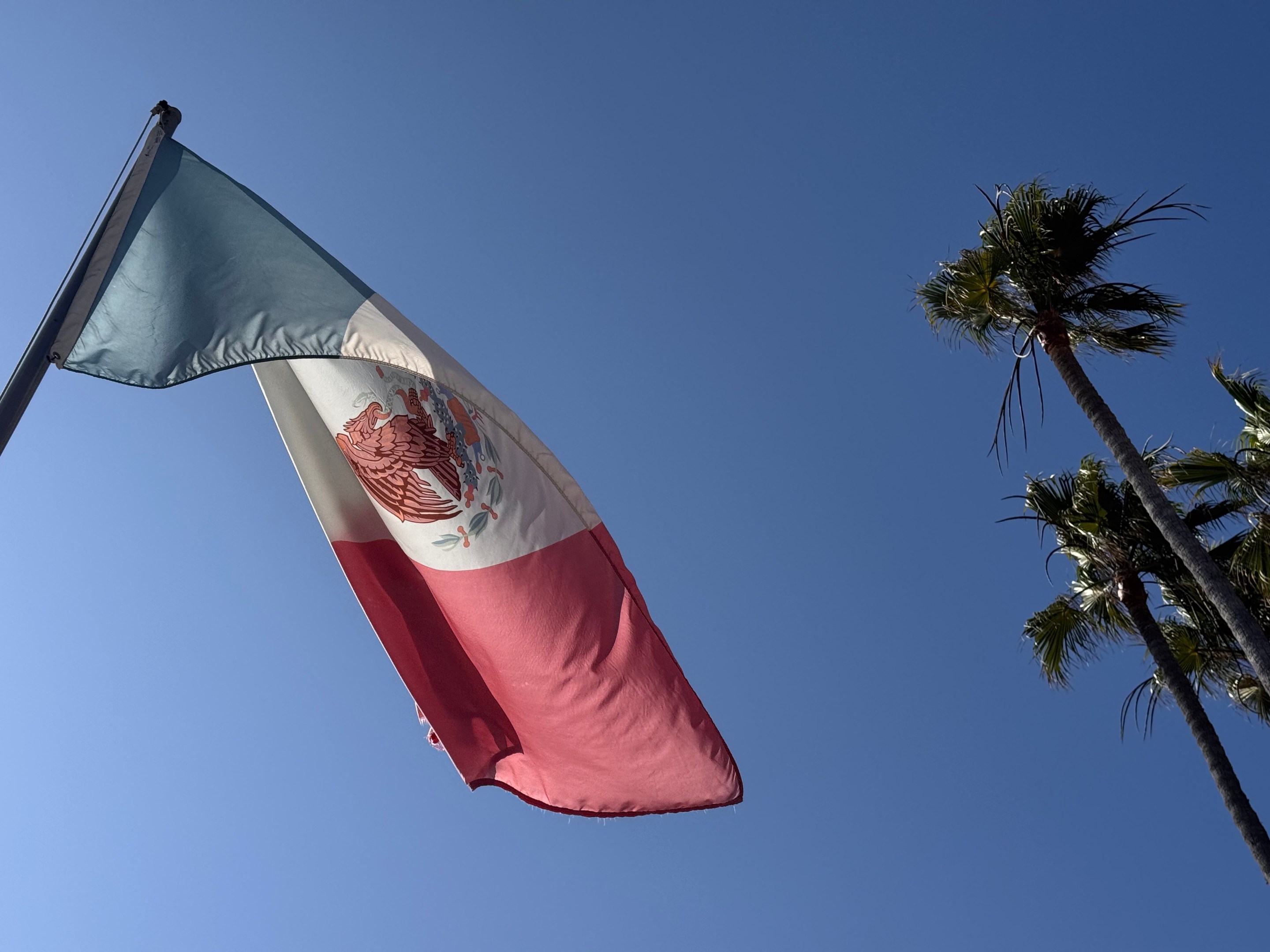
Delicious oysters pulled from the sea just a few hours ago are shucked, sauced, and served poolside at a private resort, where the owner of a national chain of steakhouses is soaking in a hot tub with Hollywood writers, internationally known musicians, a European business entrepreneur, and a rich retiree from Palm Desert. If it wasn’t for the giant Mexican flag flying over this Rosarito villa, I’d swear I was in an episode of White Lotus.
Except this isn’t HBO. This is real life. Baja life. Specifically, the life that’s unfolding in 2025, where the American Dream seems to be reversing course, southward.
Rosarito, once the party beach for working-class Angelinos and college kids on spring break, has become a strange new stage where the global rich, the pandemic-era remote elite, and the disillusioned American retiree class have converged. But here’s what’s even more surprising: affluent Mexicans are also spending their money at golf courses, Michelin-rated eateries by the sea, and cruises that drift from one magical beach town like Ensenada to another like Puerto Vallarta.
According to chef José Figueroa, this trend began during the first term of the Trump administration.
“From a Tijuanense point of view, it’s been crazy,” he says. “In Trump’s first term, a lot of us got to experience racism and assault for the first time in our lives.”
Figueroa, who runs the Michelin-recognized Carmelita Molino y Cocina in Tijuana, used to love crossing into the U.S. for a Costco run, some In-N-Out, and maybe a stop at a dispensary. Now?
“I’m at a point in my life that I don’t care if I ever go to the U.S. again,” he tells me. “And I dare to say the way I feel is the way millions of Mexicans feel.”
The Numbers Tell the Same Story
According to a report by Travel and Tour World, air travel from Mexico to the United States decreased by nearly 10% this past spring, with business travel down a significant 19%. And it’s not just Mexico—international tourism across the board is down. In the first quarter of 2025, foreign arrivals to the U.S. dropped by almost 9%, and international visitor spending is projected to fall by $12.5 billion this year alone.
Meanwhile, the U.S.'s once-massive cultural influence appears to be waning. A recent Pew Research poll found that Mexican public opinion of the U.S. has sharply declined since Trump returned to office. And it’s not just about politics—it’s the whole package: immigration raids, mass shootings, inflation, and the anxiety of just existing in public spaces. It's enough to make an Ensenada summer sound a lot more laid-back.
I spoke with a white developer, who asked not to disclose their real name. They left the U.S. for Mexico City after the Trump tariff war started. Now they are working on their cutting-edge AI app in a gentrifying neighborhood of Mexico City. Working-class Mexicans call U.S. immigrants working remotely in Mexico and earning dollars "digital nomads," blaming them in protests for rising living costs in Mexico City.
They told me point blank, “America is a dystopia right now, and here, it's just so normal. Like the stuff happening over there barely registers,” they told me. “And I’m telling you right now, none of my rich friends are even thinking about going to America anytime soon. Normally, they’d be spending all this money in the U.S. for the summer. Now they’re just vacationing in Europe, or here, or other places in Latin America.
And Yet, Americans Keep Coming—To Mexico
While fewer Mexicans are traveling to the U.S., more Americans are moving to Mexico than ever before. According to El Pais, record-breaking 1.6 million U.S. citizens now live south of the border, up 70% since 2019. That includes retirees, remote workers, families, and a growing number of people who are just over the rising costs, political chaos, and broken systems back home.
And I get it. In Rosarito, the average monthly rent for a one-bedroom apartment by the beach is about $487 USD, according to the online database Livingcost. In L.A., it’s closer to $2,368. That means it’s 70% cheaper to rent in Rosarito … and you’re by the beach! But wait there’s more.
According to Medical Tourism, a website dedicated to tracking traveling for medical expenses, a visit to the doctor or dentist in Mexico can be as much as 80% cheaper. On average, a trip to the dentist for something as simple as a porcelain crown will cost you about $2,500 in the US and just $250 in Mexico.
But more importantly, there is a thriving community in places like Las Playas de Rosarito, where you can still take a stroll and hear three generations of families laughing outside on a Thursday. For a lot of Americans, that’s priceless.
Places like Ensenada, Sayulita, and San Miguel de Allende have become havens for a certain type of American seeking cheaper cost of living, better weather, and an easier lifestyle. Real estate agents in Baja call it “el boom gringo.” Okay, I made that up.
However, I did speak with a realtor named Lewis, who represents clients in New York, and he informed me that Americans are buying in Mexico more than ever.
“There is a workaround to buying property if you aren’t a Mexican citizen,” Lewis explained. “There are even some financing available these days. The government has made it really easy to help the growing demand.”
Lewis makes it seem simple, but there are several hoops that non-Mexican citizens have to jump through to buy property.
Mexico has what’s called a “restricted zone”—essentially, any land within 50 kilometers (about 30 miles) of the coast or 100 kilometers (about 60 miles) from an international border. Foreigners are not legally allowed to directly own land in these areas. Instead, they must set up a fideicomiso, a type of bank trust that holds the property on your behalf, typically through a Mexican financial institution.
It’s not inherently shady, and many Americans do it, but it does come with annual maintenance fees, legal costs, and a substantial amount of paperwork. And when people want to sidestep those costs, that’s when things get risky. Some buyers go the prestanombre route, where you use a Mexican national to “hold” the property title in their name, trusting that everything will work out. Sometimes it does. Other times, people get burned, losing their investment to scams, handshake deals gone wrong, or legal disputes with friends and family that don’t exactly favor foreign ownership.
So yeah, you can get that $750,000 seaside villa in Rosarito. Just make sure you read the fine print—and don’t let the ocean view distract you from the land laws.
It’s Not Just Economic. It’s Emotional
A few miles up the coast from the poolside oyster party, a massive prop from James Cameron’s Titanic sits on a pier where tourists can order artisanal coffee and churros while they wait to take selfies with it. The film was shot close by at Baja Studios. All over the area, you’ll find relics from the film that feel like a monument to ambition, disaster, and the spectacle of things falling apart.
Which feels... kind of perfect.
Because that’s the undercurrent humming beneath all this movement. It’s not just about money. It’s about fear. About comfort. About how people want to live. The same way affluent Mexicans used to romanticize trips to Aspen to ski or Rodeo Drive to buy designer luxury wear, they now daydream about Porto or Copenhagen. And just as Americans once fled to New York or San Francisco for a better life, they now dream of tacos by the beach and life-style they can actually afford.
But there’s tension, too.
In Mexico City, more protests have erupted in Roma and Condesa over rising rents, cultural displacement, and the influx of American digital nomads. The anger isn’t about vacationers—it’s about people changing neighborhoods, economies, and cultures without ever fully integrating. Sound familiar?
As someone who grew up spending summers going back and forth between Southeast L.A. and Tijuana or Sinaloa, this new migration wave feels like it’s writing a different kind of border story. One where Americans are the ones trying to blend in, to reinvent themselves, to “find peace” somewhere else. And Mexicans, many of whom once looked up to the U.S. as a dream destination, are deciding they’d rather stay, or go anywhere but there.
Is it the conquista (colonization) all over again? A new wave of outsiders reshaping the land, using up precious resources away from the natives, and creating new dreams? Or is it something else entirely, a mutual reimagining where borders blur and everyone’s chasing their own version of paradise?
Come back at me with your thoughts after your next mezcal-soaked evening followed up by tacos de birria for breakfast.