
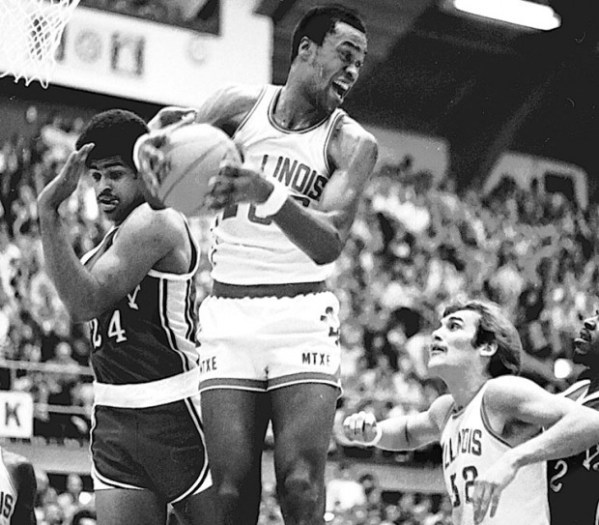
Lewis Brown (left, UNLV) in 1977
UPDATE, September 16th, 2011: Today the New York Times reported that Lewis Brown has died.
The NY Times recounts the story of Lewis Brown, drafted by the Milwaukee Bucks out of UNLV and one of 250,00 homeless people living in Los Angeles County. The former basketball prodigy, a center from Compton who the LA Times described in 1973 as “the best basketball player in the history of the C.I.F. Southern Section," sleeps on the sidewalk but has the respect of local merchants who say he is like a caretaker of the neighborhood.
These days, Mr. Brown spends much of his days at the Mobil station, washing drivers’ windows as they pull in for gas. As dusk fell one recent night, he headed for home, a pile of boxes and blankets on a patch of sidewalk set among the production studios south of Santa Monica. “Vine is mine, all the way down to the 7-Eleven,” Mr. Brown said, his huge frame lumbering down the street, nodding at people who know him from his 11 years on these streets, as well as a few who still recognize him from his basketball days.
At 56, Mr. Brown’s life is an arc of triumph and defeat, of lost opportunities and wasted potential. In his view, he is here — one amid the thousands in this city’s churning sea of homeless — because of coaches who could not understand his emotional turmoil, who never appreciated his talent. Conversations with him are long flights of anecdotes and self-congratulatory statistics that, if impressive in detail, are scarred by bitter recollection of endless slights. Keep reading...
Lewis Brown is both typical and atypical of the homeless population in Los Angeles. Some facts about homelessness in LA:
The average age is 40 - women tend to be younger.
33% to 50% are female. Men make up about 75% of the single population.
About 42% to 77% do not receive public benefits to which they are entitled.
20% to 43% are in families, typically headed by a single mother.
An estimated 20% are physically disabled.
41% of adults were employed within last year.
16% to 20% of adults are employed.
About 25% are mentally ill.
As children, 27% lived in foster care or group homes; 25% were physically or sexually abused
33%-66% of single individuals have substance abuse issues.
48% graduated from high school; 32% had a bachelor degree or higher (as compared to 45% and 25% for the population overall respectively).
Race General Population Homeless Population
Latino 47% 33%
White 30% 14%
African American 9% 50%
Asian/Pacific Islander 12% 2%
Other 2% Less than 1%