

It’s a Thursday at 7:45 a.m. Elysian Park Playground, overlooking Dodger Stadium and Downtown L.A., is still and serene, with not a soul in sight.
But a couple of minutes before 8 o’clock, a tinny voice on a loudspeaker slices through the hush in the air. It’s hard to make it all out, but one statement is unmistakably audible:
“The line is clear.”
After a short beat of dead silence, rapid live fire from the LAPD Police Academy rings out through the ravine, killing any semblance of tranquility. It’s a sobering reminder of why L.A. TACO came to the playground in the first place.
From the most prescient and heart-wrenching to the flat-out bizarre and outrageous, here’s our guide to the L.A. filming locations for ten infamous movie death scenes.
Spoilers ahead . . .

"REBEL WITHOUT A CAUSE (1955)
James Dean is so goddamn cool and commanding as troubled new-kid-in-town Jim Stark in "Rebel Without a Cause," Nicholas Ray’s teenage melodrama of parental neglect and the mental anguish it bears, that his meek new friend, "Plato" (Sal Mineo), is mostly overlooked during the 24-hour odyssey of self-discovery—and that’s the idea.
As if the situation couldn’t get any dire after high-school bully Buzz (Corey Allen) takes a nose dive off a cliff while racing Jim in a game of chicken, things take a turn for the worse when Plato, who has been essentially abandoned by his parents, snatches a loaded pistol from under a pillow in his mom’s bed and runs to warn Jim that Buzz’s goons are after him.
Plato shoots and kills one of the gang members at an abandoned hillside mansion—the same exterior used for Norma Desmond’s house in "Sunset Boulevard" (1950)—and heads for the Griffith Observatory, certainly the most apropos L.A. location for a character nicknamed after the Greek philosopher whose theories on the cosmos influenced later astronomers and thinkers.


Jim and Judy (Natalie Wood) follow Plato into the closed Observatory as the police position themselves outside.
In an effort to protect Plato, Jim surreptitiously removes the clip from the gun before handing it back. But a sense of foreboding remains in the near-pitch-darkness of the planetarium—used earlier in the film as a thematic precursor to its climax—as Jim attempts to escort Plato outside to surrender. When police spot Plato’s shiny pistol still grasped in his hand, they turn on the lights from their cruisers, and Plato makes a run for it, prompting the cops to shoot him dead.
The societal sacrifice of a kid screaming out for someone to love and to be loved in return is a heart-sinking moment that is only exacerbated by Jim screaming, “I got the bullets!” while holding the clip in his outstretched hand.
Chilling, to say the least.
Griffith Observatory ~ 2800 E. Observatory Rd. Los Angeles, CA 90027

"CHINATOWN" (1974)
“Forget it, Jake, it’s Chinatown.”
"Chinatown"'s infamously defeatist credo caps one of the most cynical finales ever put to film, and feels as timely today as it must have during Watergate and the final days of the Nixon administration.
In the 1974 neo-noir starring Jack Nicholson as private detective Jake Gittes, the rich and powerful are above the law and can get away with anything—even murder.
In an attempt to save the inescapably tragic Evelyn Mulwray (Faye Dunaway) and her daughter/sister (if you know, you know), Katherine (Belinda Palmer), from the clutches of Evelyn’s filthy rich father, Noah Cross (John Huston), Jake must return to Chinatown, a haunting, omnipresent place from his past.


Forced at gunpoint, Jake takes Noah to the rendezvous with Evelyn in Chinatown. As Katherine is escorted to her mother’s car, Noah makes a beeline for her, and Evelyn pulls a gun on her father.
After grazing Noah in the arm with a shot, Evelyn gets behind the wheel of her 1938 Packard Twelve and takes off with Katherine. With Evelyn still under suspicion for killing her husband, Hollis Mulray (Darrell Zwerling), the chief engineer for the Department of Water and Power, the cops on the scene shoot at the fleeing vehicle. As the car comes to a slow stop, the blaring of its horn and Katherine’s shrill scream can be heard from down the block. Jake runs to the car and opens the driver-side door; Evelyn’s lifeless body, with a golf ball-sized hole through her eye socket, falls out.
Noah Cross walks away with Katherine in his custody, while Chinatown has yet again claimed the life of a woman that Jake has failed to protect.
N. Spring Street & Ord Street, Chinatown, Los Angeles

"ASSAULT ON PRECINCT 13" (1976)
In John Carpenter’s second feature film, "Assault on Precinct 13," a contemporary urban take on Howard Hawks’ "Rio Bravo" (1959), a multi-racial South L.A. street gang called Street Thunder has a cache of stolen assault weapons and lays siege upon a defunct police precinct in the final stages of relocating. The few remaining stewards of the building, brought together through disparate circumstances, must work together to save their lives.
But it is the film’s inciting incident that contains what is arguably the most shocking image of Carpenter’s entire cinematic oeuvre.
As a father (Martin West) and his young daughter, Kathy (Kim Richards), drive around a “horrible neighborhood” looking for the street where the girl’s nanny lives, members of Street Thunder cruise the territory with an automatic rifle pointed out the car window. The shooter is ready to randomly kill at any moment, but when the gunman hears the music of an ice cream truck, he takes a pause.

Just then, as Kathy’s dad stops at a payphone booth to get directions to the nanny’s house, the little girl spots the same ice cream truck—parked along Berendo Avenue and what is today the 105 freeway—and asks her dad for some money. The ice cream man is on edge, having spotted the cruising gang vehicle, but once it looks like the coast is clear, he happily sells Kathy an ice cream cone. But the rattled ice cream vendor gives Kathy the wrong thing!
When she returns to the truck, the gang members are there, and one of them, completely void of emotion, shoots Kathy in the chest. Carpenter’s sustained synth score cuts out and the little girl drops to the ground.
It’s heart-stopping, it’s gut-punching, and, above all, it’s royally fucked up.
West Athens ~ Berendo Avenue near 115th Place, Los Angeles, CA 90044

"A NIGHTMARE ON ELM STREET 3: DREAM WARRIORS" (1987)
At the Westin Hills Psychiatric Hospital in Springwood, seven teenagers, all suffering from some type of sleep disorder, are experiencing what their doctors call a group psychosis—nightmares haunted by the same boogeyman. Their dreams are dismissed by the doctors as extensions of real-life trauma until Nancy Thompson (Heather Langenkamp), the protagonist of 1984’s “A Nightmare on Elm Street,” shows up. Nancy’s grad work on pattern nightmares has earned her an internship at the institution.
Upon Nancy’s arrival at Westin Hills, the exteriors of which were filmed at UCLA’s Royce Hall, she’s introduced to some of the kids, including Phillip (Bradley Gregg); the orderlies call him “The Walker” on account of his tendency to sleepwalk.

In what is perhaps the most memorable and heinous kill of this fan-favorite “Nightmare” film, known for its twisted practical effects, good ol’ Freddy Kruger (Robert Englund) slices open Phillip’s arms and legs, pulling out an artery from each and stringing him up like one of the marionettes he’s made as a hobby.
Freddy leads Phillip through the hospital corridors, the bloody arteries painfully pulling him to the top of one of the hospital’s towers. To anyone watching, it appears that Phillip is sleepwalking, but Freddy dangles the terrified teenager over the tower’s ledge before cutting the strings with his notorious glove.
The other kids in the institution know that Phillip is not a casualty of suicide, but rather a victim of their shared boogeyman.
Royce Hall ~ 340 Royce Drive, Los Angeles, CA 90095

"DIE HARD" (1988)
It’s Christmas Eve and a group of East German terrorists have taken over Nakatomi Plaza. It’s up to New York cop John McClane (Bruce Willis)—who just arrived in L.A. hoping to reunite with his estranged wife, Holly (Bonnie Bedelia)—to take out the terrorists and save the hostages hunkered down on the building’s 30th floor.
Famously filmed at Fox Plaza, the 34-story tower adjacent to the 20th Century Fox studio lot was brand new at the time. Some of its top floors were still under construction and the building itself felt isolated amongst L.A.’s urban sprawl.

After John has picked off most of the bad guys one-by-one, he faces the mastermind of the terrorist-robbery plot, the highly astute and methodical Hans Gruber (Alan Rickman), who is using Holly as leverage to escape. But John is one step ahead. He shoots Hans, who stumbles back into a shot-up plate-glass window. As Hans crashes through the glass, he grabs hold of Holly’s arm on the way out. When John undoes the wristwatch gifted to his wife by her sleazy, coked-up boss, Hans plunges to his death.
The scene is among the pantheon of movie deaths, considering the filmmakers famously dropped Rickman from 40 feet above a blue screen-covered air bag on a soundstage—releasing him on the count of one rather than the pre-determined count of three—to capture a natural reaction.
Fox Plaza ~ 2121 Avenue of the Stars, Los Angeles, CA 90067

"BOYZ N THE HOOD" (1991)
This one hurts. It’s a shock to the system so great that it can't be shaken—and it shouldn’t.
The late John Singleton’s seminal, unflinching masterpiece of Black teenage life in South Central Los Angeles drew from the filmmaker’s own experience: living with his mother in one part of South L.A. before going to live with his father in another part of South L.A.
The coming-of-age tale revolves around three friends who largely grow up on the same block: Tre (Cuba Gooding Jr.); Doughboy (Ice Cube); and Doughboy’s half-brother, Ricky (Morris Chestnut). Of the group, Ricky, a star football player at Crenshaw High School, has a shot at getting out of the hood with a potential scholarship to USC, Singleton’s real-life alma mater.
But, as Tre’s dad, Furious (Laurence Fishburne), so ardently asserts, a society built on institutionalized racism has pre-determined plans for young Black men in the hood.
During a cruise night on Crenshaw Boulevard, Ricky gets into a heated confrontation when he is purposely shoved by a member of an opposing gang. Coming to Ricky’s aide is Doughboy, who flashes a piece tucked into his waistband.
The rival gang retreats, but the deed is done, setting up the tragically symbolic shooting death of Ricky in an alley about three miles north of the 5900 block of Cimarron Street, the film’s main location, in Chesterfield Square.
Jefferson Park ~ Alley at W. 30th Street between 4th Avenue & 5th Avenue, Los Angeles, CA 90018

"TERMINATOR 2: JUDGEMENT DAY" (1991)
Sarah Connor (Linda Hamilton) has a recurring nightmare. She walks up to a chainlink fence where, on the other side, children are playing with their guardians on a pristinely manicured playground overlooking downtown Los Angeles. In one of the dreams she even sees herself playing with her child while dressed in the coffee shop uniform she wore at her job in "The Terminator" (1984).
But the Sarah watching from the fence knows what’s coming. It is the day when the machines wipe out most of human civilization in a nuclear holocaust. The date is August 29, 1997—Judgement Day.


Sarah, looking on, tries to warn the people on the playground, but her voice can’t be heard. And then, the blast. Sarah’s body bursts into flames, as do all of the people on the playground. As Sarah screams in agony, Los Angeles is reduced to rumble in a furious orange blaze.
When the blast radius reaches the playground, the charred remains of the park’s inhabitants crumble; the skin on Sarah’s body explodes from her skeleton, which is still holding onto the fence.
Jolted awake from her nightmare, one of the most intensely catastrophic film sequences ever made, Sarah is prepared to prevent Judgement Day from happening.
The playground at Elysian Park was built specifically for the film and removed when filming wrapped at the location.
Elysian Park Playground ~ Located in Elysian Park, Los Angeles, CA 90012

"FACE/OFF" (1997)
Almost 30 years later, John Woo’s off-the-wall L.A. action picture “Face/Off” is just as much delirious fun as it was upon its release.
With psychopathic terrorist Castor Troy (Nicolas Cage) in custody but in a vegetative state, FBI anti-terrorism agent Sean Archer (John Travolta) must undergo a physical alteration through which he can temporarily adopt Castor’s face and assume his identity to learn the location of an active bomb that could flatten a square mile of Los Angeles and release a biological weapon.
When the real Castor unexpectedly wakes up from his coma and demands he be given Sean’s face, the mission to disarm the bomb turns into a vital race to preserve Sean’s very existence.

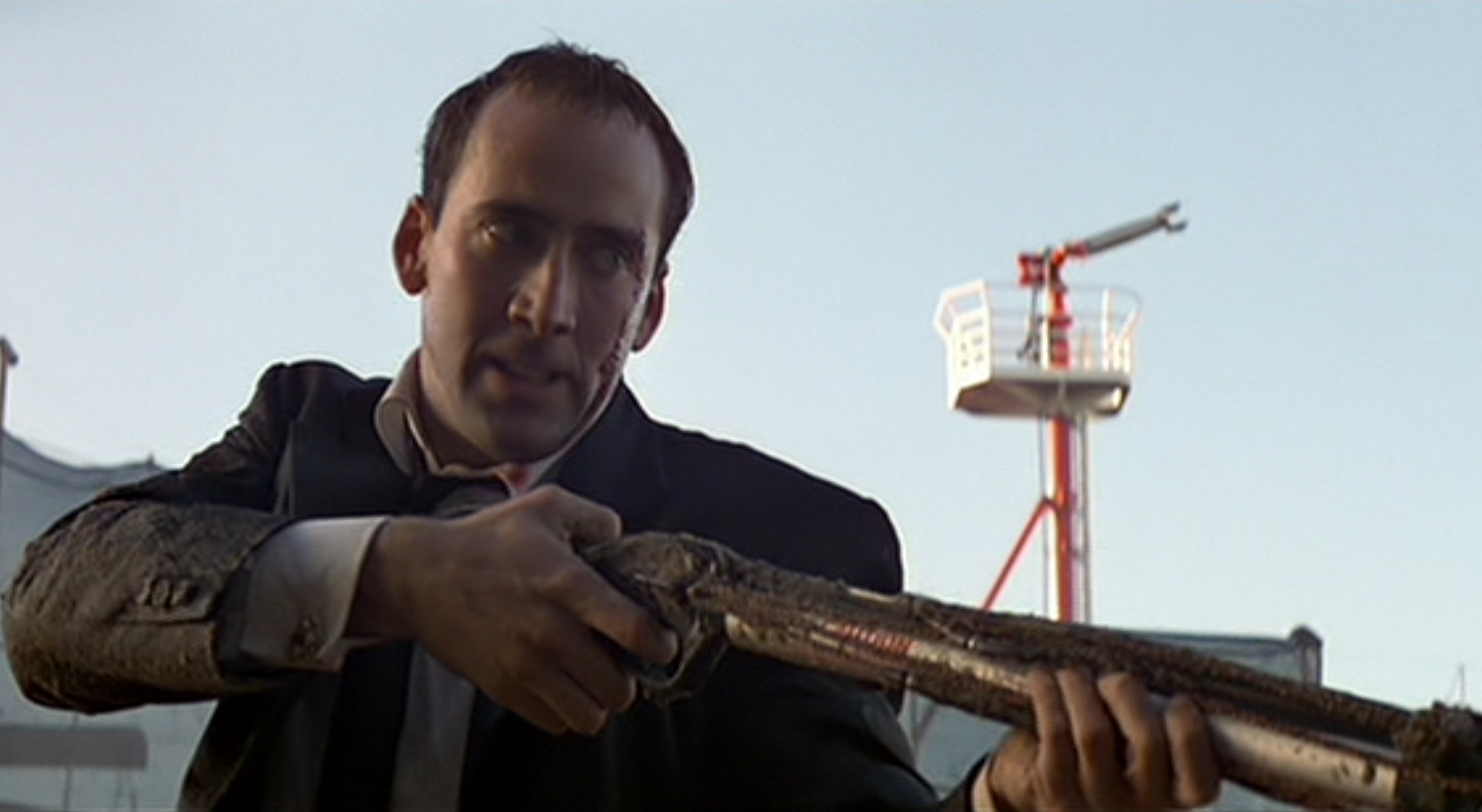
Though “Face/Off” is punctuated with multiple hard-hitting, adrenaline-fueled set pieces, directed in Woo’s signature balletic style, it’s the film’s nearly 20-minute final showdown (complete with white doves), starting at the Cabrillo Beach Bath House and continuing through the waterways of San Pedro, that results in the ultimate retribution.
As the hijacked speedboat on which they are fighting crashes, Castor and Sean are launched through the air, landing on the sandy shores of Al Larson Boat Shop, a marine repair facility established in San Pedro in 1903.
No more guns, just whatever is within arm’s reach: a broken piece of glass; a lead pipe; and a loaded speargun from the speedboat, which Sean (Cage) uses to put an end to Castor (Travolta). But the fight isn’t complete until the former, with an expression of frenzied shock on his face, maniacally screams, “Diiiiiiiiiiiiiiiie!” Classic Nic Cage.
Al Larson Boat Shop ~ 1046 S. Seaside Avenue, Terminal Island, CA 90731

"AMERICAN HISTORY X" (1998)
In the middle of the night, two young Black men approach the Vineyard residence; one stands guard with a handgun on the steps leading up to the front door as his partner uses a crowbar to break into a car in the driveway.
Derek Vineyard (Edward Norton), the hardened leader of a Venice neo-Nazi skinhead gang, races downstairs in his boxer shorts. Swastika, Iron Cross, and ‘white power’ tattoos adorn Derek’s muscular torso. Upon throwing open the front door, Derek shoots and kills the man standing on the steps before turning his gun to the guy breaking into the car, injuring him with a few shots. Finally, Derek unloads his clip at the getaway car, but the driver speeds away.
The black-and-white sequence then flashes forward to full color, but there’s more to the incident at the Vineyard house.
In a subsequent flashback shot on the Venice Beach basketball courts, Derek makes a bet against the guy previously seen breaking into the car. The wager: whichever team loses—white vs. Black—walks away from the courts for good. When Derek’s team wins, two and two are put together. The opening robbery is not simply retaliation for loss of the courts, but a pointed response to the vile racism that the act represents.

Nearly half way through “American History X,” after Derek, now on a better path, has been released from prison, we’re sent back to the film’s start. As the getaway car drives off, Derek returns to his incapacitated victim, who, forced at gunpoint, is ordered to put his mouth on the curb. The young man trepidatiously complies; shot in extreme closeup, his front teeth scrape the cement.
The horrifying act comes to a shocking conclusion as Derek stomps on the back of his victim’s head. Derek’s brother, Danny (Edward Furlong), collapses to his knees in numbing disbelief on the front lawn.
The depraved act is so disturbing that the resulting imagery is forever burned into the collective consciousness of modern cinema.
2206 Meade Place, Venice, CA 90291

"THERE WILL BE BLOOD" (2007)
Roughly halfway through Paul Thomas Anderson’s sweeping tale of greed and familial discord, wily self-made oil man Daniel Plainview (Daniel Day-Lewis) says to a man claiming to be his brother, “There are times when I look at people and I see nothing worth liking. I want to earn enough money I can get away from everyone.”
After amassing a fortune from his wells and an infinitely lucrative pipeline deal, Daniel builds an isolated mansion where he lives as a recluse, fueling his established eccentricities and paranoia with incessant alcohol consumption.

While the seconds-long exterior establishing shot of Daniel’s Los Angeles-set mansion is that of Thornewood Castle in Lakewood, Washington, the interior couldn’t have been a more inspired choice.
Though a popular filming location for decades prior to “There Will Be Blood,” the Greystone Mansion in Beverly Hills was built in 1927-28 by oil baron Edward Doheny for his son Edward Jr. The senior Doheny is the loose inspiration for “Oil,” the novel upon which “There Will Be Blood,” was based.
Incidentally, Edward Doheny Jr. was shot and killed by his friend and trusted aid in a murder-suicide in one of the mansion's guest bedrooms.


It is in the mansion’s two-lane basement bowling alley—restored for the production—where things come to a head between Daniel and his arch-enemy, Eli Sunday (Paul Dano), an opportunistic evangelical preacher from Little Boston, the small rural California town of which Daniel bought up the land and struck it big.
Eli arrives with a proposition to drill upon a tract of land he believes to be untouched, but he’s sorely disappointed to learn that Daniel has already drained the property of which Eli was hoping to reap the monetary benefits. Exposed as the sniveling charlatan that Daniel always knew him to be, Eli becomes the target of Daniel’s vengeful, drunken rage.
After haphazardly launching bowling balls in Eli’s direction, Daniel strikes the back of Eli’s head with a wooden bowling pin and proceeds to finish the job by bashing in the preacher’s skull.
At Greystone Mansion, there will be blood.
Greystone Mansion ~ 905 Loma Vista Drive, Beverly Hills, CA 90210
Follow Jared on Instagram at @jaredcowan.


