


Skip to Content
Cheap Eats

Master of Fermentation: An Interview with David Ehreth of Sonoma Brinery

478443_449568808465491_203166401_o

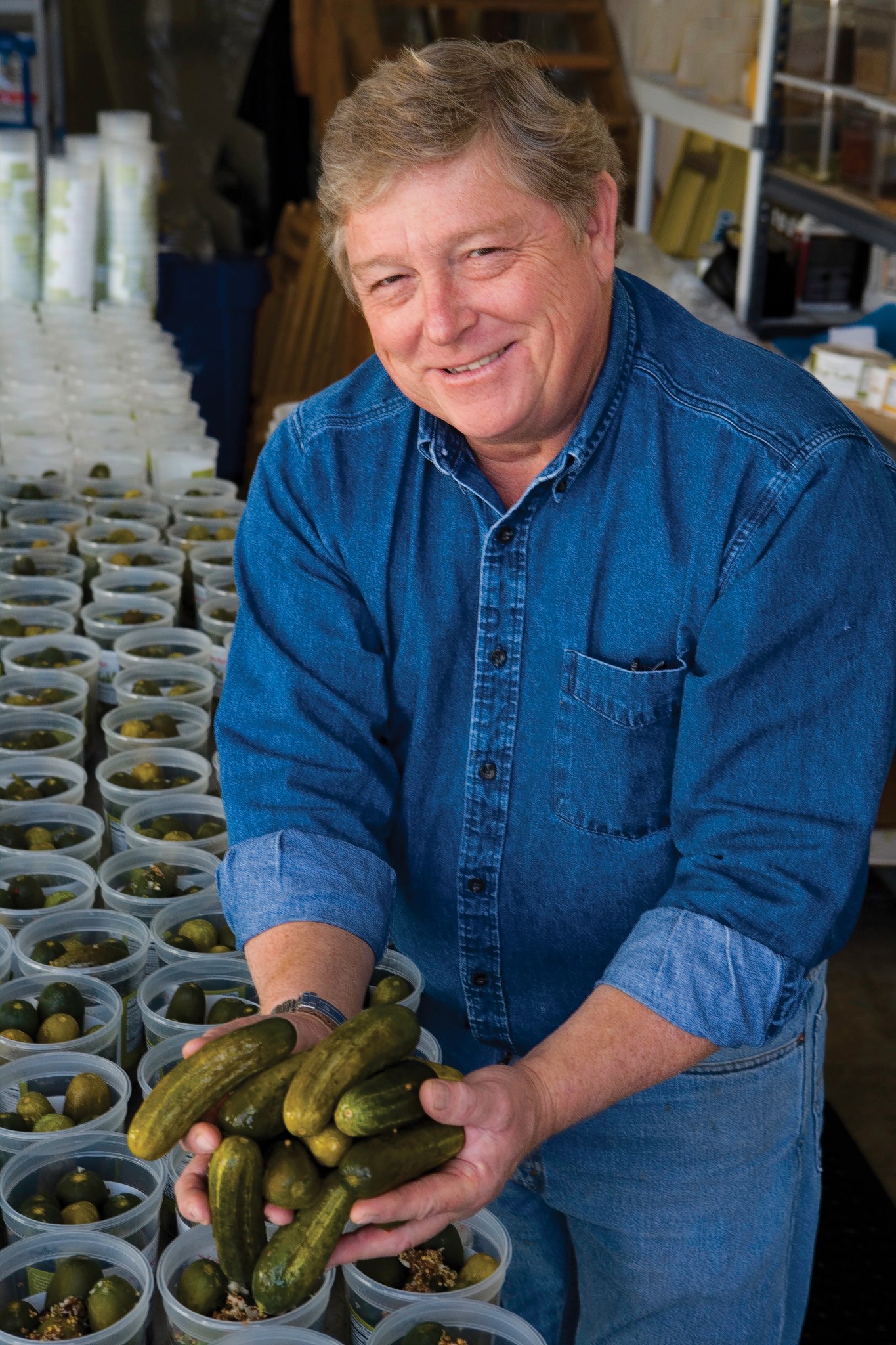
Sonoma Brinery makes the best pickles we've ever bought from a supermarket. We've wanted to interview founder and master fermenter Dave Ehreth, a former engineer, for a long time just based on his kosher pickles, but were surprised and thrilled to find out he's also interested in Mexican and Central American foods. Here we discuss the art of pickling, and his new products which include a curtido and Jalapeños en Escabeche...

Do you remember the first great pickle you ever had?
Yes. My father took me to a restaurant in San Francisco when I was young, Tommy’s Joint. He wanted to show me what a true kosher pickle was like; fermented, no vinegar, completely fresh. He was from New York and knew what a great kosher should be like. From that moment, when I was about 10 years old, I have been in love with real kosher pickles. I mean, really in love with these pickles. I used to drive 40 miles to San Francisco just to get a few of these pickles. Later in life, when I traveled on business to New York, I would round up kosher pickles and bring them home on the plane.

What got you into the pickling business?
After 30 years in the tech business, I decided to launch a second career; I was going to bring this great pickle to the West Coast. I saw the food revolution change our bread from white bread to baguette, iceberg lettuce to arugula. But our pickles were still vinegar and chemical soaked imitations of the real kosher. The true kosher is a harder pickle to make and manage, but just like the white-bread-to-baguett transition, worth every bit of the effort.

What, in your mind, makes a truly great pickle?
Great pickles begin as great cucumbers. A truly great pickle should be fresh, crisp, lightly acidic, mildly salty and have all the character of the cucumber it was made from. When you eat a great pickle, it should feel light on the pallet and should not leave you feeling like you just drank a cup of battery acid.

1498739_562293803859657_303450210_o

Where do you source your cucumbers from, and what do you look for in a good cuke?
During the summer months, we source our cucumbers from several farms in the Central Valley. As winter approaches and through early spring, we get our cucumbers from a farm in Culiacån, Mexico.

I've heard a lot about fermented and live foods being really good for you. Do you consider your products to be "health food”?
When I think of the term "health food", I think of food that has more “health” value than taste appeal. I like to think of our products the other way around. First, they have to taste great so you will eat a lot of them. Second, they must be really good for you. That way, you end up eating a lot of food that is also really good for you. Fermented foods are great. They contain probiotics (bacteria that our bodies need to break down organic molecules to make nutrients available for our bodies while providing natural antibiotic functions that protect us from bad bacteria) and are rich in enzymes (organic compounds that work as catalysts to aid our metabolism of food). Unpasteurized, fermented foods are raw and contain all of their original nutritional value plus the probiotics and enzymes developed during fermentation. How much healthier can food get?

Have you seen any use of your pickles in Mexican food yet?
¡Si! Nearly everybody at Sonoma Brinery is of Mexican heritage except myself and my partner/cousin Jill. Two of our partners are first generation Mexican immigrants, now American citizens. So, when we all sit down to lunch, you can bet that what we make here finds its way into many traditionally Mexican dishes. For example, we see cucumber pickles (koshers and bread and butters) showing up in sopa seca de arroz and sopa seca de fideo.

You haven’t lived until you put some of our traditional sauerkraut in your pico de gallo. Enchiladas verdes (de pollo o puerco) served on a bed of our curtido will knock your socks off. Many of the “ kitchen sink” caldos and sopas that we see at the lunch table feature surprising combinations of both our sauerkraut and pickles.

Who’d of thought? But, if you think about it, a napolito is a lot like a gringo pickle. Why not use them interchangeably when you want to change up a recipe a little bit?

As long as we are on the subject of the use of our products in Mexican food, we here at Sonoma Brinery believe that the latino-influenced market is grossly underserved by the “artisan" food community. Very often, the “artisan” food producers aim their products at a select demographic that seems to have an endless ability to pay ridiculous prices for high quality food. Much of that “artisan” food traces its roots to northern Europe.

Our next set of products are aimed at bringing the high quality normally associated with “artisan” foods to latino markets at affordable prices. In this set of offerings we will be offering our Curtido and our new Jalapeños en Escabeche (fermented, fresh and incredibly good) along with other products still in the R&D phase. Yes, there are a lot of jalapeños in the market today, but we intend to do for jalapeños what we did for the kosher pickle, namely, make them the way they were traditionally made. OK, this is a commercial, but don’t take my word for it. Try them.

1490580_579173648838339_194414567_o

[Editor's note: we tried the curtido and it was sensational. A big upgrade in terms of freshness and brightness over the usual version given on top of pupusas, but with all the complex traditional flavors. The jalapeños were even better-- they brought out the essence of the pepper, and when released should become the new standard in California]

What inspired you to do a curtido?
In 1973, a friend and I entered Mexico in Nogales and walked, road busses and hitchhiked to Costa Rica. Along the way, we stopped in El Salvador and were introduced to the pupusa and its companion, curtido. That began a long-standing interest in what I think of as “alternative” sauerkrauts… various mixtures of fermented vegetables. When I got serious about making regular sauerkraut, I began to experiment with curtido. What I really like about it is its versatility. Yes, it is the best thing in the world on top of a great pupusa, but put it on a grilled cheese sandwich and you are in a whole other ball park! I think it is one of the most versatile products in the sauerkraut family.

1421249_567160336706337_1201467571_o

How about the jalapeños?
Jalapeños en escabeche-- One of my partners and our production manager, Mayra, went to work on this product about a year ago. I think she’s produced one of the finest jalapeño/escabeche products I’ve ever had. The difference is that there is no vinegar in these beauties, they are purely fermented. We plan to introduce Mayra’s Jalapeños en Escabeche at the 2015 Winter Fancy Food Show in San Francisco. They will hopefully be in stores a month or two after the show.

Why do some picklers use vinegar, and why do you stay away from it?
Short answer: vinegar processing is easier and results in a longer lasting pickle-like product. We don’t rely on vinegar processing because the traditional fermenting process results in better flavor, texture and nutrition.

Long answer: Before the industrial revolution, pickles were not made with vinegar. During the industrial revolution, we learned how to mechanize the production of corn, learned how to can using heat pasteurization and learned that botulism could be suppressed with acid. When corn vinegar was invented in the 1800’s, it was quickly adopted into a new process called “vinegar pickling”. When this process was combined with pasteurized canning, the modern vinegar pickle was born. Prior to this, pickles, all pickles, were fermented and relied on naturally occurring lactic acid for tartness and acid. Lactic acid, made by lactic acid bacterial (LAB) appears in many foods and is very friendly to the tongue. Lactic acid is found in sour cream (crema), salami, wine, sourdough bread and our kosher pickles.

When it was discovered that the new vinegar processing could produce a pickle-like substance that had the single advantage of nearly endless shelf-life at room temperature, it was all over for real fermented pickles. And the only things we lost in that transition: flavor, texture and nutrition. We use vinegar in our bread and butter pickles because you can’t ferment sweet things, and I like sweet things. We even produce a hybrid fermented/vinegar brined pickle. Vinegar has a place in modern pickling, to be sure. But, for me, comparing traditional fermented pickles to vinegar-based pickle-like products is like comparing a great baguette to a loaf of white bread. Yes, on the day after Thanksgiving, I always look forward to my turkey sandwich on white bread. But, the other days of the year, it’s the baguette. It just tastes better.

10514387_703337769755259_2037758039314202765_o

Where can people in L.A. get Sonoma Brinery pickles and other products?
We have quite a few venues in the LA area. Of the larger chains, Whole Foods, Bristol Farms and Gelsons. Many quality grocers with fewer stores also carry our products as well. Mothers Kitchen and Market would be an example.

Visit Sonoma Brinery on Facebook.

Stay in touch

Sign up for our free newsletter

More from L.A. TACO

How Jim Henson’s Forgotten ’90s Puppet Entered Foo Culture and Is Feeding Our Endless Nostalgia Craving

Could the Sesame Street creator have ever imagined Baby Sinclair rocking a pair of Nike Cortez’?

February 21, 2026

Daily Memo: ICE Pepper-Sprays and Throws an 80-year-old Attorney, Arrests a Community Watcher, and Takes Seven From Lompoc

Video shows a couple of agents piled on top of Randamaa, shoving his head to the ground as other community members watched in anger and horror. An 80-year-old attorney trying to advocate for the agents to get off Randamaa was pepper-sprayed in the face by one of the agents pinning down Randamaa with the signature Yoga Cobra Pose. As he was pepper-sprayed, you can see the lawyer throws his hands out while blinded, being eventually thrown to the ground by the Yoga agent. 

February 20, 2026

Weekend Eats: Ramadan Feasts at Maydan, Aguja Tortas In Hollywood, and Goat Machito In East L.A.

new dek: "Plus, a new Hokkaido-style fried chicken sandwich from a ghost kitchen in Pico-Union and a new filet mignon taco in Studio City. "

February 20, 2026

Daily Memo: ICE Used 14 Vehicles to Take 6 People from Rancho Cucamonga Courthouse

So essentially what we’re seeing is that Border Patrol is still active down in San Diego, along with ICE. Here, ICE is operating out of their local offices in Santa Ana and San Bernardino. We also know that people are being taken in Los Angeles who show up for their check-ins. These incidents are hard to catch, observe, or document, but we've confirmed that they're happening.

February 19, 2026

The 24 Best Fish and Seafood Tacos In Los Angeles, Mapped

From scallop tacos to fish machaca flautas to a smoked marlin gobernador, here is a taco crawl for our pescatarian friends, and those just looking to eat less meat.

February 19, 2026

Punk Bands Are Bailing on ‘Punk in the Park’ Over Founder’s Trump Donations

L.A. woman-fronted punk band, Naked Aggression, was the first band to pull out. L.A. TACO confirmed that N8NOFACE is also withdrawing from the festival taking place in Vallejo, California, as of this morning. Other bands, like 8 Kalacas, are doubling down and still performing.

February 18, 2026
See all posts