* This story was originally posted in February 2018.
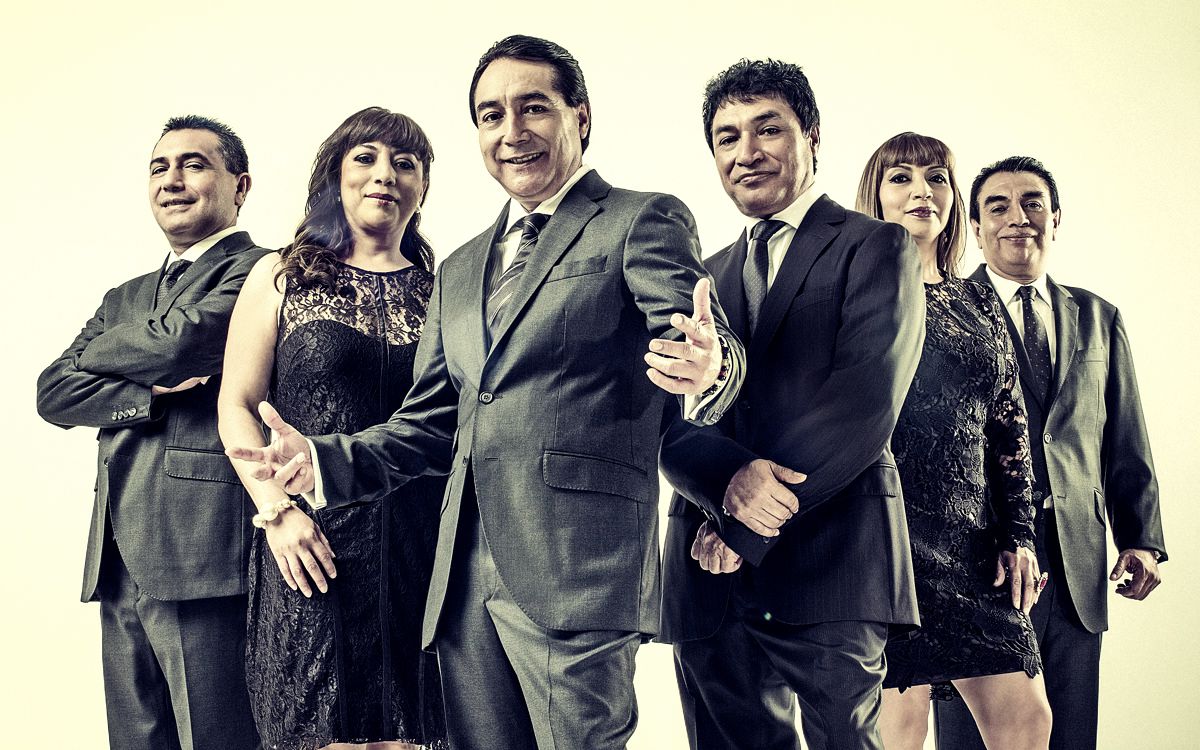
If all Los Ángeles Azules ever recorded was “El Listón de tu Pelo” and “Como te Voy a Olvidar,” their status in Mexican party history would still be forever secured. These cumbia románticas remain slow-jam staples at quinceañeras, weddings, and bedrooms across raza-dom thanks to the song's soft horns, plaintive lyrics, and furtive synths.
Those are just the most famous tunes in a 40-plus-year career that has seen the group become perhaps the most famous cumbia group in Mexico, and one of the most chameleonic in Mexican music overall after Café Tacvba. They started with straightforward cumbias that mimicked the endless shuffle of the Colombians who had migrated to Mexico City in the 1950s, then jumped into the romántica obsession with chintziness during the 1980s. Los Ángeles Azules changed their approach again in the 1990s, when the sound system-esque glories of cumbia sonidera became popular in Mexico City.
But what always remained was their ability to make people move. “The music is so universal—all you have to do is feel it,” says lead singer Erick de la Peña in Spanish from Mérida, where Los Ángeles Azules recently toured. “After hearing us, it's impossible that people don't feel padre.”
And now they're selling out arenas with their latest innovation: cumbia sinfónica, where the group takes stages with all their classic sound but now backed by a full orchestra. They'll be at the Honda Center this Valentine's Day with this combo, and you haven't cumbia'd until you do "Entrega de Amor" backed by strings as bright and sharp as anything out of Vivald's “Four Seasons.”
Mexico's alt-rock musicians have long championed the group — witness Los Ángeles Azules's 2013 compilation Cómo Te Voy a Olvidar, which saw them re-record their greatest hits with the likes of rock en español god Saúl Hernández, former Los Fabulos Cadillacs lead singer Vicentico, chanteuses Lila Downs and Carla Morrison, and more (the best track from the record: “Mis Sentimientos” with Ximena Sariñana, which remains among the slinkiest tracks ever recorded).
Now, hipster America is scheduled to discover them this spring at Coachella, where Los Ángeles Azules will make history as the first Mexican popular music act to ever play at the festival. “It's an honor,” says de la Peña. “We know how important this is. We're going con todo el show.”
Their appearance there also marks an important milestone in the history of cumbia: it's finally getting #respect.
In Mexico, cumbia's three-step shuffle has seeped into everything from banda Sinaloense to conjunto norteño, but the music still gets dismissed as a corny naco phenomenon—the Bruno Mars of the country. Simple beats with nothing really there.
The genre's main practitioners, from Los Ángeles Azules to Grupo Kual to Los Askis, remain virtually unknown to American audiences, even as L.A. Chicano groups from Los Lobos to Quetzal to La Santa Cecilia, Ozomatli, Chicano Batman — really, all of them — have used the rhythm to signify latinidad in their sets for decades. But it's inevitably a weaker track, a gimme for each group when they don't want to try yet need to keep the party going — and in Southern California, cumbia has been around long enough that even gabachos can scratch out a couple of dance moves.
It's an unfair spot for cumbia. Much like Jamaican music and its breakneck evolution from ska to rocksteady to reggae to dub, Mexican cumbia has always been the most innovative of the country's popular music cultures. Its sub-genres—colombiana, andina, sonidero, romántica, and others—are legion and sprout new branches with seemingly every technological advancement. The music gets its vibrancy from urban areas. And it's something that De la Peña takes pride in.
“We've ripped through socioeconomic and generational barriers,” de la Peña says. “Part of the magic is that we're loyal to our style — romántica. We don't overthink it or wonder if it's in style or if it's commercial. Any new elements we incorporate is to refresh el pueblo.”
It's those shared working-class roots that further endear Los Ángeles Azules to their fans. To this day, they always rep Iztapalapa, the crowded Mexico City colonia from where the group's core hail and from where the Mejía Avante family started it in the 1970s. When they play in the United States, it's usually at a convention center or Cinco de Mayo festivals, or small dance clubs across Southern California — not traditional arenas but rather flat, large spots where the group's core chilango and poblano followers can dance.
“Our primary function for them to enjoy the moment, after they work,” says de la Peña of their fans. “El sonido is a thing that hopefully will never get lost. Because it's from el barrio.”
Their appearance at the Honda Center is geared primarily toward regulars, but de la Peña is also excited to play at Coachella to people who have never heard of them. “It's supposed to be people who are open to music, right?” he says. “Then we'll be fine.”
I tell him about what happened at last fall's Tropicália Fest when hipsters stood still during a set by Los Tigres del Norte. Wasn't he afraid that same crowd would do the same at Coachella?
”Cumbia is very difficult not to dance to,” de la Peña says with a laugh. “No estamos preocupados.”
Los Ángeles Azules plan to record a new album this year which will feature more collaborations. De la Peña urges fans to actually buy an actual record instead of a digital download. “It's beautiful to go to a store and buy something and give it to someone,” he says. “It's now like es una cosa underground. It's not in a cloud, and you can play it at any time and hold it.”
He also has some words for Latinos in the United States who feel threatened in this era of Trump. “We're the economic motor of that country,” he says, referring to los Estados Unidos. “Our fans know that, and I have hope that things will get better. Instead of being divided, we need to unite and behave ourselves as a community. I hope our music contributes to that.”
Los Ángeles Azules play with Kinky, Raymix, and La Cuñeta at the Honda Center, 2695 E. Katella Ave., Anaheim, 8 p.m. $99 (you waited too long to buy tickets, codos)