
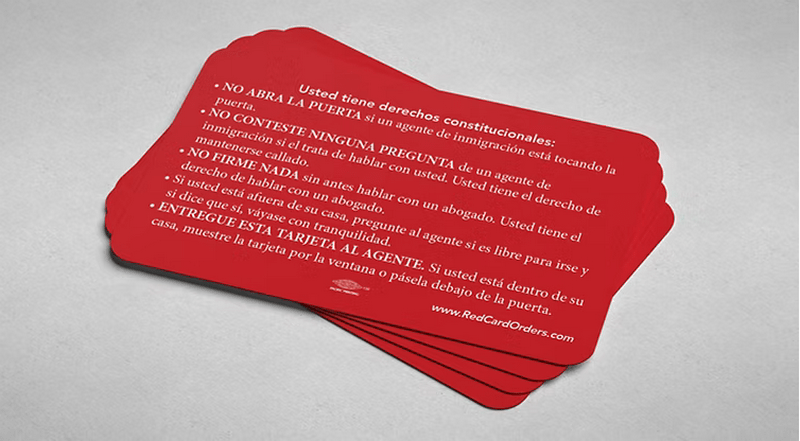
The Red Card/Tarjeta Roja was created by the Immigrant Legal Resource Center (ILRC) to apprise people about their Constitutional rights and protections in this country.
The card is available in over 50 languages, so that anyone encountering DHS or law enforcement agents are informed of, and able to assert, these rights, regardless of whether they may speak the same language as the agents.
ILRC has also laid out an easy-to-understand graphic with text in a few different languages, explaining how the stated rights can be asserted.
"The intention of the red card is to inform people of the rights that they have here in the United States," Veronica Garcia, senior staff attorney at Immigrant Legal Resource Center and a co-leader of its "Know Your Rights" team, tells L.A. TACO. "It's to give people a way to assert those rights if they don't feel comfortable speaking to someone. And also [if] there's a language barrier."
While the cards have notably been available to neighbors in immigrant communities and for the use of undocumented individuals in the U.S., Garcia notes that everyone should carry one, regardless of their immigration status.
Not only to be educated on their rights themselves, but additional, in the efforts of unity and allyship during these times of aggressive government overreach, in which the presence of a red card may lead to agent assumptions about one's documentation status.
"That way, it's harder to make these like identifications of 'only undocumented people use the red card,'" Garcia says. "It's important to be like, 'no, we're all using the red card, we're all asserting our rights.' And that [red card] is not enough for immigration to arrest you and it's a violation of the rights if they do use this as a way. It's important to encourage all of us to use the red card, regardless of status, because it creates unity and it's harder to single out one person if we're all doing it right."
Two weeks ago, L.A. TACO's Memo Torres reported that people may have been detained by I.C.E. after showing red cards in the presence of DHS agents. The cards are not directly responsible for anyone's detainment, which more often than not comes down to agents' own methods of profiling and assumptions, based on factors such as skin color.
Garcia notes that the card is intended to educate its holder, as well as to be shown, to demonstrate to the agents that the other person in the encounter has and knows their rights. Particularly in cases where verbal communication is a challenging.
"I recommend that people continue to assert their rights, you know, that if they feel comfortable asserting the rights of other rights verbally, they should go ahead and tell the officer that they're asserting the right to remain silent, that they're asserting the right, and they're not going to answer any questions, etc.," Garcia says.
"If they don't feel comfortable, I think the red card is still a great tool to use to show the officer that you are asserting your rights and that you know your rights," she says. "I think the red card is something that we should all use, regardless of status, right, because as we know, unfortunately, how officers are identifying people is not because of the red card, it's more because of how people look."
There's no way to predict the exact outcome when showing the card and in no way is it a "get out of jail card."
In an era when federal judges, civil rights groups, pundits, and untold numbers of people in the country have accused I.C.E. of making unlawful detentions amid a constantly evolving, unpredictable situation, anything could essentially happen, including violations of the same legal protections and rights asserted in the cards.
Still, Garcia notes the impact the red card has had during the frightening escalations of the past year.
"We've definitely have heard of situations where people have used the red card, and they, or their rights, are still being violated, right?" she notes. "They're still ending up arrested."
"And we have heard of situations where people have asserted their right to use the red card, and immigration officials have left them alone," she continues. "We have heard stories of it being useful. Of people showing it . . . when officers come to someone's house, right, and them slipping it under, or when someone's in a car. What happens or how rights are violated could depend on how what actions are taking place."
Ultimately, even under the terrifying threat of a detention, the card could potentially help a detainee's case in the future.
"I think it's important to remind community about it being a way to educate you on your rights, and to tell the officer that you know your rights and so that they are aware that you know your rights," Garcia says. "Because you are taking that step to assert your rights and showing them that you know your rights . . . that could potentially also help down the line if you do end up in immigration proceedings."
The ILRC reached out to L.A. TACO to add the following additional context around the red cards:
- We know that with a rogue agency, red cards or asserting your rights generally may not prevent an arrest. But they remain a valuable tool in fighting a deportation case. This is because asserting your rights can preserve a “motion to suppress," a valuable defense in immigration court when ICE uses illegally obtained evidence.
- The red card does not give ICE probable cause to arrest anyone. In other words, ICE can't legally use this as a basis to arrest someone. We know that ICE arrests people unlawfully, but we still remind folks that they can choose to assert their rights (which preserves the valuable defense named above).
- It’s not the red card that makes someone a target initially, it’s sadly racism that motivates ICE to approach people initially. If ICE means to arrest someone based on racist factors, they’ll likely arrest them with or without a red card. (But again, asserting rights remains important because of the above defense!)
- We encourage U.S. Citizens to carry red cards too. And truly, we should all be asserting our rights before any law enforcement.
- We can’t control the federal government’s unlawful acts, but we can control our actions and how we exercise our rights. Will it always prevent an arrest, no, but it preserves a valuable deportation defense down the line.
ILRC also has this resource for companies, detailing how they can use the red card in their own business. People can also download this free explainer of the red cards here to display, and red cards can be purchased in bulk here.
Full disclosure: The Immigrant Legal Resource Center (ILRC) recently awarded L.A. TACO with a recognition for our work covering I.C.E. raids.