After slamming into an overpass guardrail above the 118 Freeway in Porter Ranch during a high speed pursuit that exceeded speeds of 100 mph, the driver and four passengers jumped out of the allegedly stolen gray Nissan hatchback.
“Hey, get on the fucking ground!” An LAPD officer who had been trailing the Nissan shouted as the driver and another passenger hopped over the guardrail and fled down an embankment onto the westbound side of the freeway.
“Turn around and get on the ground!” The officer shouted at the remaining passengers, who seemed to struggle to hear him over the sound of helicopter blades circling above. Meanwhile, the driver and the other passenger slipped into the darkness.
An hour later, a dark-coated police K9 named “Erros” and a team of specially trained LAPD officers explored the brush underneath the Tampa Avenue exit of the 118 Freeway in search of the driver.
Oftentimes just the presence of a K9 at a crime scene and an audible warning over a loudspeaker is enough to make a suspect give up. Police dog bites are rarely fatal, but their jaws are strong enough to cut through sheet metal, and their bites are at times indistinguishable from shark attacks or bullet wounds, according to experts.
The LAPD’s K9 Unit was established in 1980, out of the department’s West Bureau with just two canines, at a time when police departments across the Southland were experimenting with using dogs. By the mid-’90s, LAPD K9s bit people on average nearly every day.
It didn’t take long for the lawsuits to pour in. In 1991, the American Civil Liberties Union of Southern California filed a class-action lawsuit against the LAPD alleging that police dogs mauled hundreds of people, the majority of whom were either Black or Latino.
“These dogs are trained to attack and maul,” civil rights attorney Barry Litt told the L.A. Times in 1991 after the lawsuit was filed. “. . . It’s like a live chain saw. It is literally unleashing vicious animals with no justification.”
The ACLU’s lawsuit argued that police K9’s should only be used when suspects posed a serious threat of death or physical injury to officers.
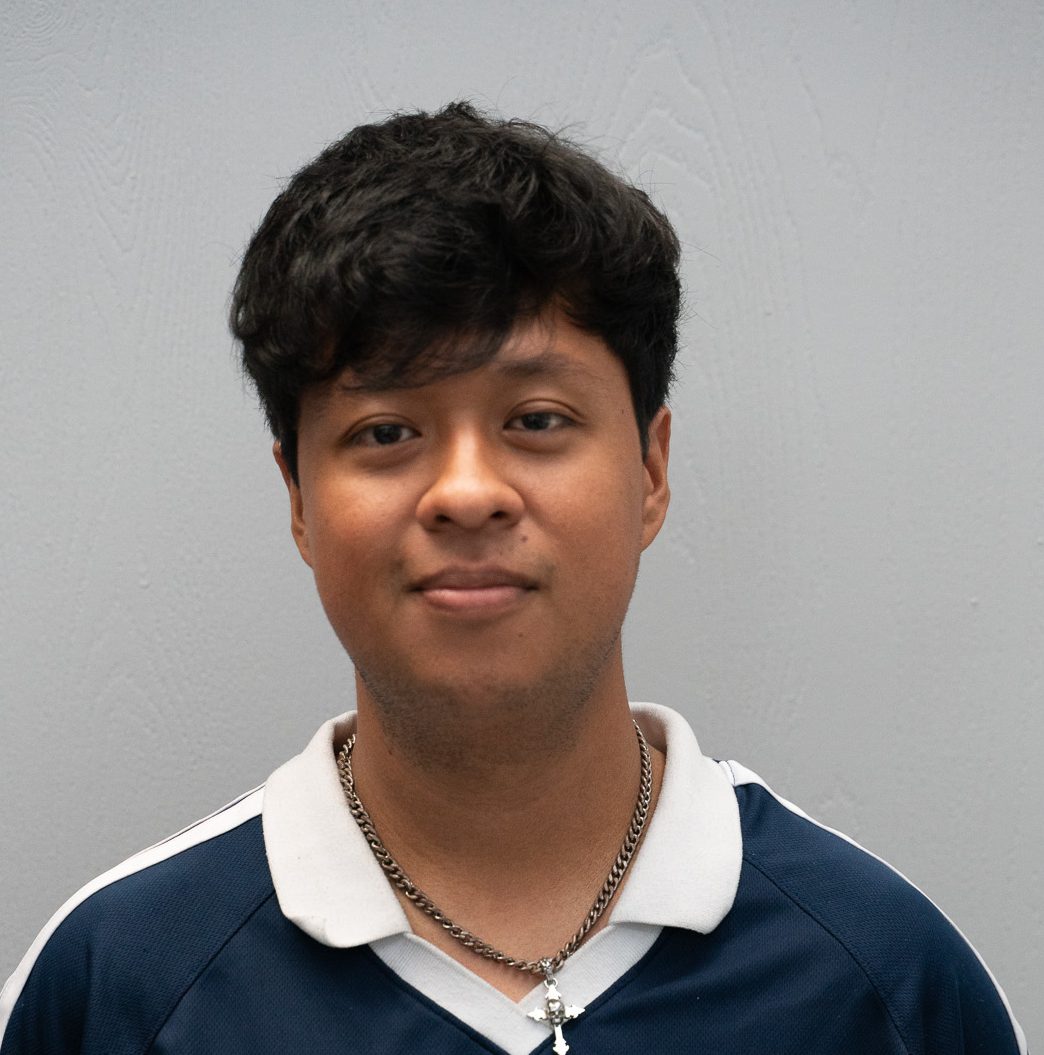
Back on the night of the chase, lit by a flashlight, the LAPD K9 ran ahead of its handler, LAPD Officer Michael Hernandez, before it stopped in front of the driver of the allegedly stolen Nissan, 18-year-old Andrew Valdez, who was lying down underneath a leaf-less tree. The dog's tail wagged while the sounds of freeway traffic loomed in the background.
An LAPD sergeant had determined that the incident met the criteria for a K9 search because one of the occupants of the vehicle had been injured, which made Valdez a suspect for felony evading with great bodily injury. But Valdez was not believed to be armed.
The near silence ended with Valdez letting out desperate expressions of pain, as the dog sunk its canine teeth into his left forearm, just below the elbow.
“Alright, get some cover,” the dog’s handler said, while the dog pulled and gnawed at Valdez’s arm. “Get some cover!”
“Platz! Platz! Platz!,” the handler yelled in German repeatedly in an effort to get the dog to release Valdez’s arm. But the dog seemed to latch onto Valdez’s arm for longer than expected. (Prosecutors said in a court filing that the handler saw Valdez ”pulling and pushing, or fighting with K9 Erros.”)
After nearly 10 seconds, the dog finally let go.
“Platz, Platz,” the officer yelled twice more, as the dog returned to him.
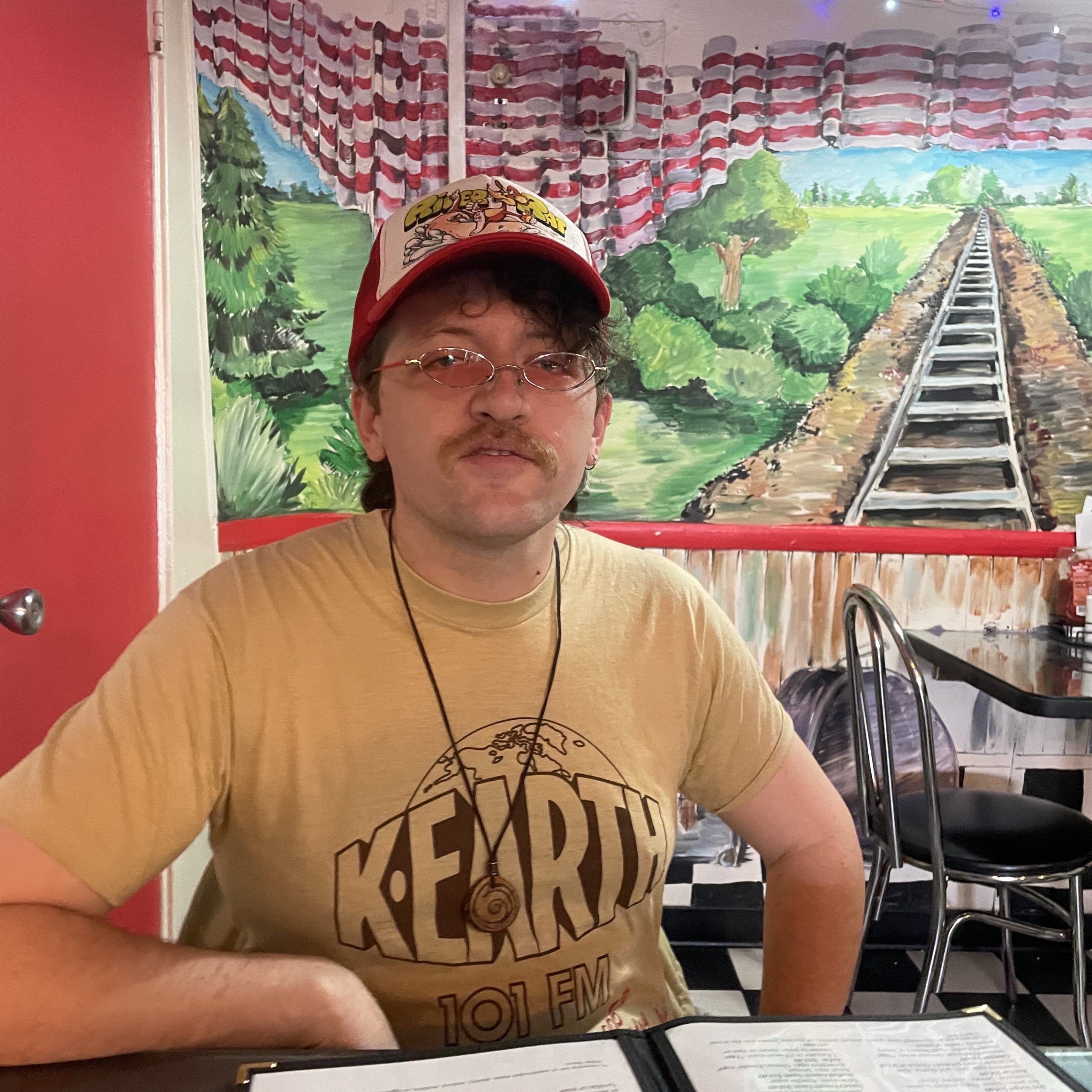
A minute or so after the attack, Valdez emerged from the brush wearing an Armani Exchange t-shirt, a Louis Vuitton belt, and no shoes. A flap of skin hung from the mango-sized laceration on his arm.
“I was just sleeping,” Valdez claimed as he slowly walked towards a group of LAPD officers and the barking K9 who mauled him. After a few steps, Valdez fell to his knees with his mouth hung open.
“What am I being arrested for?” he asked.
“What am I being arrested for?” a seemingly confused Valdez asked again. As police took Valdez into custody, an LAPD officer assured him they would call an ambulance.
Later, while Valdez sat handcuffed on the curb waiting for the ambulance, an LAPD officer wrapped his left arm with a bandage.
“It’s just a flap of skin,” another officer said, as blood ran down Valdez’s arm.
“What the fuck did I do to deserve this?” Valdez questioned.
That night, Valdez was taken to a hospital and later booked for felony evading causing great bodily harm. But a couple days later, the Los Angeles County District Attorney’s Office declined to file charges against the 18-year-old.
While being questioned after he was arrested, Valdez claimed he was unhoused and was sleeping when the K9 ran up to him and bit his arm, an L.A. County prosecutor noted in a document obtained by L.A. TACO through a public records request.
The prosecutor also noted that Valdez did not match the description of the alleged driver. A Los Angeles police officer recalled the driver of the Nissan SUV as “wearing an orange sweater at the time of the pursuit.” But when Valdez was arrested, he was wearing a t-shirt.
However, the prosecutor hinted at the idea that Valdez might not be telling the truth, since a pair of shoes and an orange sweater were recovered near the crash site on Tampa Avenue.
While being questioned, Valdez reportedly told investigators that he had “traded his shoes for something.”
But in the end, the prosecutor determined that, at that time, there wasn’t enough evidence to charge Valdez with a crime.
“ . . . charges are declined based on insufficient evidence to prove ID of suspect as driver at trial,” the deputy district attorney wrote.
Less than two months later, a joint fugitive LAPD and FBI task force arrested Valdez, this time for a crime far more serious than evading the police.
Valdez was accused of fatally shooting Gianni Washington-Parker, a 32-year-old unhoused Black man, in the Valley Glen neighborhood of the San Fernando Valley. On top of that he faced multiple robbery charges.
The month Gianni Washington-Parker was murdered was a “crazy time” for the local unhoused community, says Carla Orendorff, a volunteer for Aetna Street Solidarity, a prominent advocacy group for the unhoused based out of east San Fernando Valley.
On the same day that Washington-Parker was fatally shot, Orendorff filmed LAPD officers pulling guns on her colleagues. And a longstanding encampment on Aetna Street was “permanently displaced” by a homeless sweep conducted by the mayor’s office that month.
“[We] lost a few people who lived on Aetna Street that month,” Oredorff says, referring to people who had passed away.
There was also another young unhoused Black man named Wesley Orso who was allegedly murdered inside of a tent, just two weeks before the Washington-Parker shooting. Orso died a few miles away from where Gianni was gunned down. Both men died of fatal gunshot wounds to their chest, according to the Los Angeles County Medical Examiner.
I first started looking into this story shortly after Valdez was arrested for felony evading on October 27, 2023, the night he was mauled by an LAPD K9. I initially saw it as a story about the potential harms of police dogs, which had come under scrutiny in recent years.
I was prompted to revisit the case after listening to a Board of Police Commissioners meeting last month, during which the board considered revising the LAPD K9 Unit’s policy. As I started digging into the story more last week though, I realized I had come across a different story than I expected.
A year before Gianni Washington-Parker and Wesley Orso were killed, murders of unhoused people hit a record high. Shockingly, that year, unhoused people were the victims of one-out-of-every-three murders citywide. After peaking in 2022, those numbers have come down slightly in recent years. But unhoused people are still drastically overrepresented in homicide rates, according to LAPD data.
Even more alarming, Black unhoused residents—like Gianni and Wesley—are disproportionately represented in the data. Despite comprising less than one percent of the total population, unhoused Black residents account for roughly a third of all the unhoused people who are murdered some years.
Unhoused people are often murdered in plain view and in horrific ways. There have been unhoused people who were burned alive in their tents, bludgeoned with baseball bats, and in one case, shot by a man who prosecutors described as being “a borderline serial killer who hunted homeless people in the neighborhood."
Gianni Washington-Parker was murdered over a few dollars, according to prosecutors.
He was sitting outside of Confetti Liquor in Van Nuys—on the night of September 29, 2023—when Valdez pulled up in a Kia hatchback that he had stolen a few hours earlier. Valdez was there to pick up some cigars, but because he was only 18-years-old at the time, he couldn’t legally purchase tobacco. So after a brief conversation, he handed Washington-Parker some money to make the purchase.
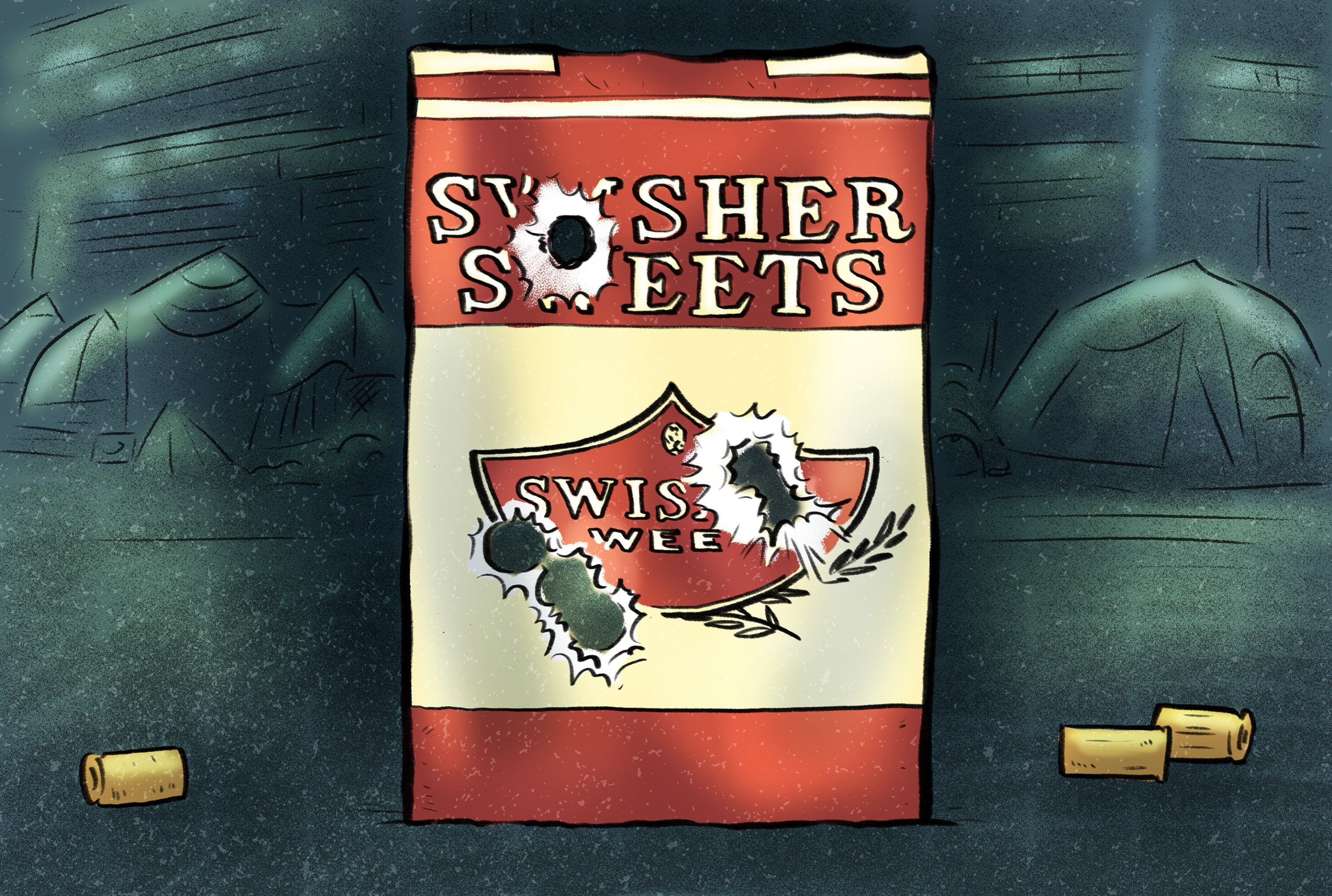
Washington-Parker walked into Confetti Liquor just before 9 PM, went up to the counter and asked for a pack of Swisher Sweets. But instead of paying for them, he took the pack of cigars and left the store.
After exiting the store, Washington-Parker walked past Valdez and his friend without giving them the cigars or the money that Valdez gave him. He continued through the liquor store parking lot, ignoring Valdez and his friend’s attempts to get the cigars and/or their money back, and headed east on Oxnard Street until he reached a parkway in the middle of the street, near Greenbush Avenue.
Meanwhile, Valdez and his friend jumped in the stolen Kia and began trailing him on Oxnard Street. Moments later, Valdez shot Washington-Parker in the back. The sound of the gunshot was captured by a nearby security camera, according to court records.
A couple hours later, a man who lived off of Greenbush Avenue observed Washington-Parker laying in the parkway. He assumed the 32-year-old was sleeping. But when he saw Washington-Parker in what appeared to be the exact same position, the following morning, he grew concerned and called 911.
When paramedics initially found Washington-Parker’s body in the grass in the middle of Oxnard Street, they didn’t realize he had been shot in the back. But after an investigator with the Los Angeles County Medical Examiner discovered a single gunshot wound to his back, they requested that homicide detectives respond to the scene immediately.
After speaking with Washington-Parker’s adoptive parent, a death investigator for the county Medical Examiner noted in an autopsy report that the 32-year-old “was homeless and would typically spend time in the Valley area train stations.”
Although Washington-Parker had a laptop, cellphone, and jewelry on him when he was shot, none of his valuables were taken. The money and cigars that Washington-Parker was killed over were nowhere to be found.
Michael Pope described Washington-Parker as a talented student athlete and musician. The two went to college in the San Fernando Valley and made music together.
“He loved anime and Japanese culture,” Pope tells me. “We're both fans of Dragon Ball Z.”
Washington-Parker and Pope attended the same college in the San Fernando Valley. He recalled that around 2017, Washington-Parker’s mental health took a turn for the worse. A year later, Pope moved to Georgia.
A few years later, Pope received a call from Washington-Parker’s sister who told him that her brother had been fatally shot.
“I didn’t know that,” Pope told me when I revealed Andrew Valdez had been convicted of killing his friend. “What evidence did they have? How did they find out it was him?”
By the time Valdez shot Washington-Pope over a pack of Swisher Sweets, he’d been on a months-long crime “spree” that involved armed robberies, carjackings, and aggravated assaults, according to a court filing.
A day before the shooting, Valdez and three other associates robbed a Macy’s in Northridge of some clothes. When a loss prevention employee confronted Valdez and his friend outside the store, Valdez pulled a gun on her.
“Go, take it,” the loss prevention worker told Valdez as he pointed a 9mm pistol at her.
"Yeah you're scared, aren’t you?” Valdez responded before taking off on foot. A few hours later, he took photos of himself wearing the clothes he had just stolen and also discussed the robbery with people on Instagram.
In total, prosecutors charged Valdez with 11 felonies stemming from seven different incidents. On top of that he already had one strike on his record for a juvenile case and “multiple gun allegations.”
Unlike the rest of his co-defendants, who were all juveniles, Valdez had just turned 18-year-old when he began his months-long crime “spree,” meaning he was charged as an adult and wasn’t spared much leniency.
Before Valdez plead guilty to all of the charges he faced, the judge presiding over his fate expressed some sympathy for the young man.
“All of those participating in this crime are juveniles, and I think unfortunately for [Valdez], his brain development was that of someone who was still a young man, even if an adult,” the judge told the prosecution and defense before Valdez accepted a plea deal that could keep him prison for the rest of his life.
The judge acknowledged the seriousness of the matter for everyone involved.
“These are not easy decisions for anyone, and they’re not easy decisions for [Valdez], and they are not easy things for anybody involved in this case . . .” the judge said.