

Story by Jack Ross
This article was produced by Capital & Main, which is an award-winning publication that reports from California on economic, political, and social issues. L.A. Taco is co-publishing this article.
[dropcap size=big]“F[/dropcap]orty acres and a mall!”
“Let us buy our mall, y’all!”
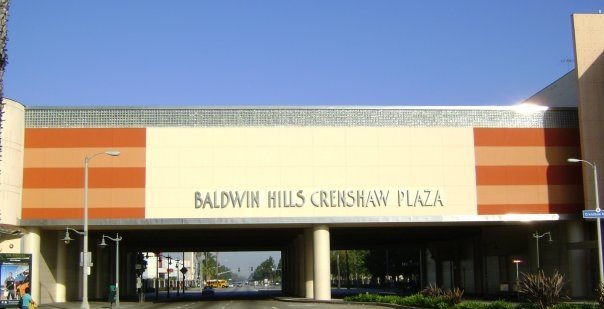
On a hot September morning in Los Angeles, volunteers from Downtown Crenshaw Rising chanted and marched in front of the Baldwin Hills Crenshaw Plaza, drawing curious looks from passersby. The Black community group has been seeking to acquire the mall for community ownership and to build more than 800 units of affordable housing while discounting retail spaces for local businesses. This August, the group financed a $100 million bid for the property; it was rejected by the bank handling the sale.
Veronica Sance, a Crenshaw resident since 1972, won over an MTA bus driver as he paused for a red light. “We made an offer!” she yelled through the glass door of the bus. “Sign the petition!” The driver, who was African American, nodded repeatedly, made a thumb-up, and pulled the bus into traffic.
Built in 1947, the mall site was originally just the Broadway and May Company department stores, along with a collection of other shops, until the 43-acre plaza was constructed in 1988. Then-mayor Tom Bradley hailed the project as the first major enclosed mall in a Black neighborhood, and Tupac featured the plaza in his 1996 video “To Live and Die in L.A.,” rapping in front of the See’s Candies store, surrounded by family and friends. But the property has fallen on hard times; Walmart and Sears both left in recent years, together vacating a third of the retail space. In 2018, the current owners decided to sell the property.
In addition to building housing in the mall, Downtown Crenshaw hopes to purchase adjacent buildings with a “community stabilization fund,” removing units from the real estate market and converting them to affordable housing. A six-acre park would provide a venue for concerts, exhibits, and performances. Plans also include office space and a community-owned hotel, whose workers would be represented by the hospitality union Unite Here Local 11, according to Downtown Crenshaw board member Damien Goodmon. (Disclosure: The union is a financial supporter of Capital & Main.)
Perhaps most meaningfully, under the Downtown Crenshaw plan, community members could buy shares of the mall itself. Their acquisition would mean Black ownership of an iconic Black commercial center, in a city still scarred by the redlining policies that primed communities of color for gentrification.
Los Angeles is now the most expensive housing market in the country; an average apartment rents for $2,524 a month. Black Angelenos make up 8% of the local population, but 34% of the unhoused population—a number likely to grow alongside rising rents—and by 2019 estimates, the city is short on affordable housing by more than half a million homes. In the 21st-century war for Los Angeles, a bitter fight between corporate real estate and the city’s desperate 99% has made a trip to the mall.
Journalist and essayist Lynell George grew up near the plaza and says it was always a “hub.” She has been anxiously keeping tabs on the Downtown Crenshaw project.