A new photography show called "Black Diamonds" is showing at La Luz de Jesus Gallery through March 1, celebrating Black outlaw motorcycle clubs through the lens of artist Alanna Airitam. L.A. TACO reached out to Airitam to ask some questions about how Black Diamonds evolved and what her time getting to know and feature the motorcycle clubs means to her.
Hi Alanna. Your new exhibit "Black Diamonds" focuses on Black outlaw motorcycle clubs. How did you get interested in this world?
Alanna Airitam: My art practice is centered around history, erasure, and representation. I am interested in what stories we decide to keep, archive, and pass down and what stories we revise, erase, and ignore. I’m also infinitely fascinated with people and our relationship to ourselves, each other, and our environment.
I came into outlaw motorcycle culture through my partner, Wayne. When we met, he was a member of a small outlaw club based out of Oakland. All the members were white. And I’ll be honest, whenever I see groups that are that visibly segregated, I get curious. And a little skeptical. I always want to understand how and why that dynamic exists.
Because Wayne was part of that world, I started asking questions. I wanted to understand the structure, the codes, the history. What makes a club a club? What’s the difference between a riding club and an outlaw club? Where did all of this come from? What’s up with the segregation? The deeper I went, the more layered it became.
What struck me was this: even though I wasn’t part of motorcycle culture, I’d still heard of clubs like the Hells Angels or the Outlaws because those names circulate in pop culture. But I had never heard of any of the Black motorcycle clubs. That absence stood out to me.
It wasn’t shocking that I didn’t know but the fact that their histories weren’t part of the broader narrative felt familiar. That pattern of visibility and invisibility. Of certain stories being amplified and others being left in the margins. That’s territory I’m familiar with.
So my curiosity shifted into something more intentional. I started thinking: what would it look like to really dig into this? To spend time and to listen and to see what’s actually there. That’s where Black Diamonds began. Not from spectacle, but from a question.
How did you initially make inroads to meeting the subjects of “Black Diamonds?”
I knew pretty early on that I wanted to document this world. It’s like a culture within a culture within a culture. Black outlaw motorcycle clubs exist inside motorcycle culture, which exists inside American mythmaking. That layering interested me. I just didn’t know where to begin.
In January 2023, I put together a formal proposal. Wayne connected me with a friend in Outcast MC. He told me he would take my proposal to leadership, but he was very direct: he was doing it out of respect for Wayne. Meaning, I had Wayne’s reputation in my hands. Don’t mess this up.
I brought the same proposal to a museum director friend who is also a member of Chosen Few. He agreed to take it to his club president. Again, I was vetted and approved. And again, it was because of Wayne’s standing. The same thing happened with East Bay Dragons.
At that point, I was grateful but also quietly wondering who exactly I was living with. The respect he carried in those circles opened doors that I would have otherwise not been able to enter.
In March 2023, I made my first portrait of a father, JTown, and his son, Youngsta, of Chosen Few, here in Tucson. The moment I saw that image, I knew. The lighting, the presence, the fact that I was not just entering a club, but I was also entering people’s families and lives. It all clicked and felt like the beginning of something important.
That photo started circulating within the club in group chats and on social media. A few months later, I was invited to the Chosen Few Mother Chapter annual in Los Angeles, where chapters from across the country converge for the weekend. It was the perfect entry point. A chance to meet people face-to-face, build trust, listen, and begin the work in earnest.
From there, it wasn’t just about gaining access but it was about the relationships.
Were there any members of motorcycle clubs who reacted negatively to the prospect of being photographer for the exhibition?
To my knowledge, I haven’t had anyone react negatively to the idea of being photographed but I also don’t push. Participation is completely voluntary. If someone wants to step in front of the camera, beautiful. If they don’t, that’s just as respected. There are a hundred reasons someone might choose not to be part of something like this, and I honor that.
Honestly, that’s part of why the energy has been so good. The people who show up want to be there. They’re curious and open. That makes all the difference.
I’m very aware that the access I’ve been given is a gift. These are tight communities. Trust isn’t automatic. It’s earned and it can be lost quickly. I take that seriously. I would never do anything to jeopardize the trust that’s been extended to me. If someone decided tomorrow that they didn’t want to participate anymore, I’d respect that immediately.
What’s been really meaningful is the response. It’s been overwhelmingly positive. I think it’s been exciting and maybe a little surreal for participants to see themselves in magazines, in museums, in spaces that historically haven’t reflected them.
I’ve met some incredible men and women through this project. They’ve invited me into their garages, their clubhouses, their homes. But beyond the physical spaces, they’ve also let me into their stories. That kind of access isn’t just logistical, it’s energetic.
The feedback has been generous. The experience has been generous. And I’m genuinely grateful for that.
Why did you choose to use the name “Black Diamonds” as the show’s title?
Let me give you a little motorcycle history, because the title really comes from that lineage.
Within biker culture, “outlaw” motorcycle clubs are often referred to as one-percent clubs. The story goes back to a statement from the American Motorcycle Association, which clarified that 99% of motorcyclists were law-abiding citizens, implying that 1% were not. Some clubs embraced that 1% label as a badge of honor. It became a symbol of autonomy away from the rules and regulations of the AMA.
If you know what you’re looking at, you can spot it immediately. The diamond-shaped patch with “1%” on the front of a cut, [or] vest. That patch isn’t decorative. It’s earned and represents commitment, loyalty, and a very specific code. You don’t just sew one on because you like the look. That could get you in a lot of trouble. That symbol carries weight and the culture protects it.
The project title, “Black Diamonds,” grows directly out of that history. Clubs like Chosen Few, East Bay Dragons, and others formed in a racial climate that didn’t make space for Black riders within white outlaw clubs. So they built their own structures, their own brotherhoods, their own legacy. The diamond patch is already a symbol of defiance and self-definition. When you place “Black” in front of it, it holds even more complexity.
The title speaks to that layered identity. The diamond as a form is sharp, faceted, and unbreakable. The diamond as a patch is earned, protected, and symbolic. Add in the “Black” as history, as culture, and as resilience within a country that hasn’t always made room.
“Black Diamonds” isn’t just referencing a patch. It’s honoring a lineage.
How does “Black Diamonds” compare to your previous work? Is there a throughline or was this a break from your past work?
“Black Diamonds” isn’t a departure from my earlier work. It’s part of the same conversation just unfolding in a different space.
In everything I make, I’m thinking about history, erasure, and liberation. I’m always looking through an art historical lens and asking who was centered, who was left out, and how we might shift that.
I’m self-taught . . . really self-taught through failure. When I first started making photographs, I was working long days in corporate offices in Southern California. I’d get home after dark, exhausted, and I didn’t have access to big studios or natural light. So I bought two used strobes and started shooting in my living room. That constraint shaped everything. I studied Baroque painting because I wanted to understand how light could carry weight and how it could elevate a subject to make them monumental. That’s when questions of representation and erasure really crystallized for me.
“Black Diamonds” carries that same DNA. The lighting is painterly and intentional. The subjects are treated with the kind of gravity historically reserved for European nobility. But the project also expands into landscape and myth.
When an OG told me, ‘We just wanted to ride,’ I kept thinking about that. The open road. Wind in your face. Pulling over wherever you want. It’s the American freedom myth we’ve seen in films like Easy Rider. But what did that actually look like for Black men in the late 1950s, navigating sundown towns, police harassment, and the necessity of the Green Book? That freedom wasn’t evenly distributed.
The backdrops reference early American landscape painting like the Hudson River School, manifest destiny, the idea of vast, conquerable land, the American Dream, freedom.
But they’re crumpled, clipped to stands, held up sometimes by other members, in garages, clubhouses, towns, and the spaces they inhabit. It’s always there. The idea of freedom is always there behind the men following them through the spaces they inhabit like a specter that’s not quite real, more like a haunting. So no, it’s not a break. It’s the same inquiry just on a different stretch of road.
Do you have any great stories from your shoots with the bike club?
There were a lot of great moments during the shoots, but honestly, one of the most memorable nights happened at the first gallery opening.
A bunch of the guys from the project showed up. For some of them, it was their first time ever stepping into an art gallery. And I know it was the first time any of them had seen their portrait hanging on a white wall like that. Watching them take it in . . . like really seeing themselves framed, lit, honored in that space was powerful. There’s something about that shift in context. Same person, different setting. It hits differently.
What made the night special was the collision of worlds. Art collectors in their tailored jackets and bikers in their cuts. These two worlds that don’t usually overlap, suddenly sharing a room, sharing stories, laughing. The conversations were real, curious, and respectful. It felt electric in a quiet way like something important was happening. I always pay attention when communities that are supposedly “unmixable” actually mix. I think that’s where growth lives.
And yes, some of the guys showed up with cases of beer because when you go to a party, you bring beer. Didn’t matter that it was a polished, fancy gallery with an open bar. That detail alone tells you everything about authenticity.
At one point I overheard this petite, older woman looking up at this massive biker and asking, completely sincerely, ‘Are you an outlaw? What kind of outlaw stuff do you do?’ He answered her gently, like they were just two neighbors chatting on a porch.
It was perfect. Not scary, not dramatic. Just human. And honestly, that’s the whole point of the work.
What is your favorite image from the show?
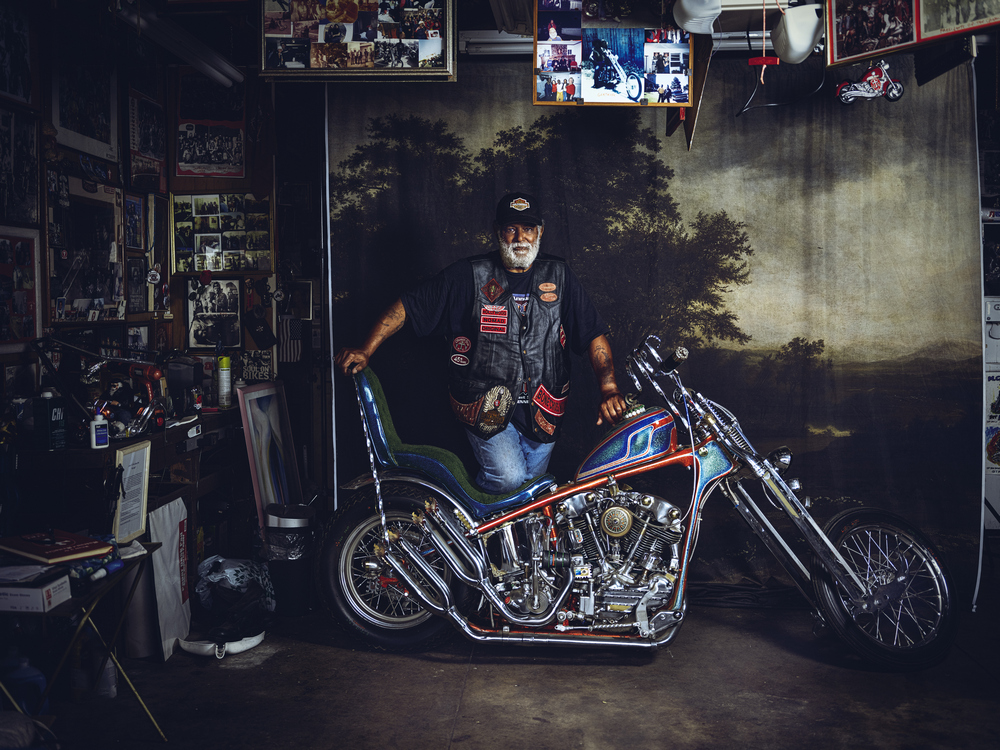
That’s always a hard question. Usually, the image I’m currently working on feels the most alive to me. But I will say, Boss Mike holds a special place.
I don’t get charmed or impressed easily. I’m observant. I take my time with people. But sitting in Boss Mike’s garage was something else. He wasn’t performing. He was just himself, telling stories about the early days of the Chosen Few, about what it meant to ride the open road and to build something of your own when there weren’t many spaces that felt safe or welcoming.
His garage wasn’t just a garage. It was a living archive. The bikes he built with his own hands. The patches. The photographs. The memorabilia spanning decades of brotherhood. It felt like being inside a self-made museum of resilience and ingenuity.
What made that portrait special wasn’t just the image. It was the exchange. The trust. I photographed him in the same way I photograph all my subjects: with intention, with gravity, with the understanding that this is history and his story.
I was able to show him the portrait before he passed away. That mattered to me deeply. He saw himself the way I saw him— dignified, monumental, part of something larger.
This work is special because it isn’t about spectacle. It’s about preservation. These men built culture. They broke the segregated biker club by becoming the first to welcome in members from all races, ethnicities, and backgrounds. They built community. They carved out space for freedom where it wasn’t readily available.
And in Boss Mike’s case, I feel a responsibility. His presence lingers in the project. When I’m working on it, I think about what he shared, the weight of those stories, the lineage. Some projects feel like assignments. This one feels like stewardship.
What understanding or feeling do you hope L.A. crowds will take away from the exhibit?
First, I want people to slow down.
These are portraits of people, not caricatures, not headlines, not the easy mythology of ‘biker culture.’ I’m not interested in reinforcing stereotypes. I’m interested in presence, dignity, and complexity. I want L.A. audiences, who are visually sophisticated and culturally aware, to really look and recognize the humanity in front of them. These men are fathers, builders, historians, protectors, friends. They are part of a lineage.
I also hope the work opens a door into a history that many people simply haven’t been invited to see. Black motorcycle clubs like the Chosen Few and the East Bay Dragons formed in the late 1950s, at a time when mobility wasn’t neutral. Riding a motorcycle across state lines carried different risks depending on who you were. So when we romanticize the open road, I want viewers to hold that romance alongside reality.
The exhibit quietly asks: what does freedom actually mean? And who has historically had access to it?
The landscapes in the work, those references to early American paintings of vast, conquerable land, aren’t accidental. They’re there to complicate the myth. The American story often centers expansion and independence. But not everyone moved through that landscape safely. So I want viewers to sit with that tension.
And beyond the political layer, there’s something deeply human here. Brotherhood. Community. Self-determination. These clubs weren’t formed out of spectacle. They were formed out of a desire for safety, solidarity, and shared joy. We don’t talk enough about how necessary that is.If L.A. crowds walk away seeing these men more fully and maybe rethinking their own assumptions about freedom, belonging, and who gets to claim space then the work has done what it needs to do.