Two incidents tied to federal immigration enforcement at churches on opposite sides of the country, one in St. Paul, the other in Los Angeles county, are raising renewed questions about whether federal law is being applied consistently, or selectively, when religious worship is disrupted.
On Sunday, January 18, in the Twin Cities of Minneapolis–Saint Paul, protestors flooded the inside of Cities Church in St. Paul after discovering that its pastor, David Easterwood, is reportedly the same top ICE official who is listed as working for the St. Paul ICE Field Office.
The Anti-ICE protestors were seen interrupting the middle of church service to chant and make their anger known about what they deem as hypocrisy for a pastor of the Christian faith to double as an ICE director.
The protestors were seen chanting, “ICE out now!” “David Easterwoord out now!” In video footage, David Easterwood does not appear to be present.
Altercations shortly took place afterward, as the St. Paul police were dispatched to respond to the sight of roughly 40 protestors inside the church.
Later that night on X, Attorney General Pam Bondi stated, “Attacks against law enforcement and the intimidation of Christians are being met with the full force of federal law,” while Trump himself described the demonstrators as “agitators and insurrectionists.”
Assistant Attorney General Harmeet Dhillon, who oversees the Civil Rights Division of the Department of Justice, shortly announced an investigation into the protest, citing a possible violation of the FACE Act.
The FACE Act prohibits “intentionally injuring, intimidating, or interfering with, or attempting to injure, intimidate, or interfere, any person by force, threat of force, or physical obstruction exercising or seeking to exercise the First Amendment right of religious freedom at a place of religious worship.”
The FACE Act of 1994 included protection to the access of reproductive health services alongside places of religious worship, and signed into federal law under Bill Clinton.
Dhillon stated on X that state prosecutors could have made arrests the day of the protest, but said that, “The DOJ must first go before a federal judge to obtain an arrest warrant,” and noted that Pam Bondi and the Department of Justice plan on seeking federal charges.
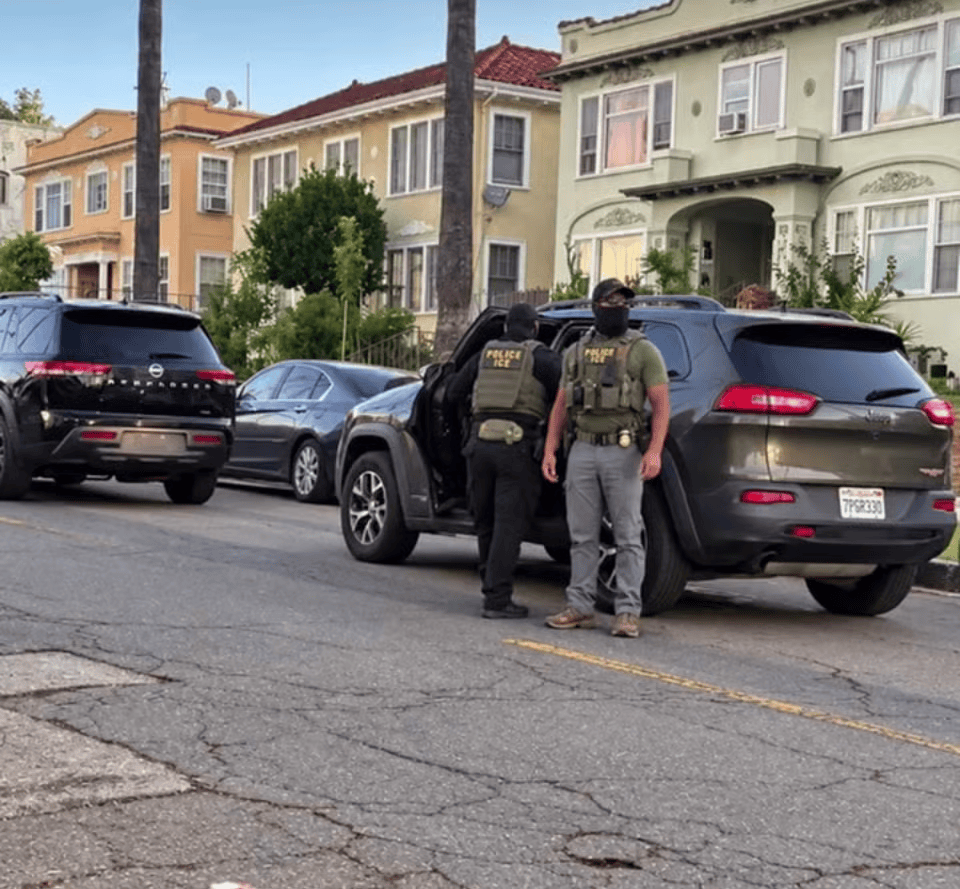
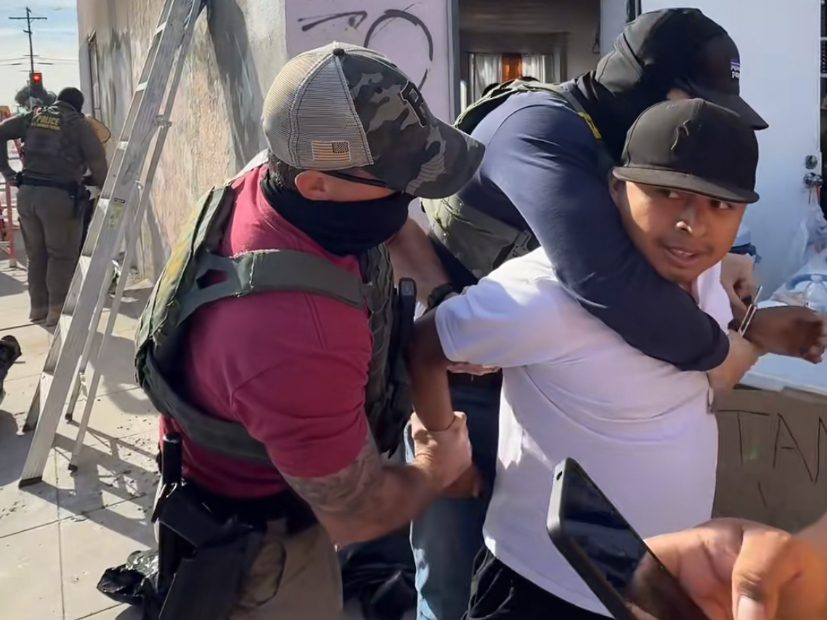
The day before the protest, another stark church interruption took place in Los Angeles County in the city of Compton. Around 10:25 a.m. on January 17th, at a small Christian church on Alondra Boulevard and Bradfield Avenue, Border Patrol agents from San Pedro’s Terminal Island were in the early stages of making a cluster raid.
It was a warm morning, and two men were outside the church painting the building, covering graffiti, and attempting to revive the structure and integrity of the place of worship.
Suddenly, Border Patrol agents stopped and hopped out of their vehicle and made their way towards the church where they apprehended the two Latino men, prompting the church’s service to come to a halt.
Members from inside the church soon rushed out and began to film and question the masked men as they took away the painters. Someone can be heard yelling out in Spanish, “They’re coming inside of a space where we preach the word of God.”
In an interview with Telemundo52, the men’s two wives were emotional and distraught, explaining that they are uncertain of what to do moving forward as they are both mothers, now left behind without their husbands or the father of their children.
This raises a question about the federal investigation unleashed at the St. Paul Church:
When is the disruption of a church service considered a federal crime?
Is it only when protestors interrupt a predominantly white congregation to challenge the conduct of its leadership? Or does it also apply when armed federal agents halt worship at a predominantly brown church by detaining individuals outside its doors?